
Blogs
Early Scoliosis Signs: What Parents Should Watch For

Scoliosis is a leading spinal condition among school-aged children, and because progression is triggered by growth spurts, the timing of treatment can be an important factor. Early diagnosis and intervention gives patients and their families more time to process the diagnosis, understand the condition, and plan a treatment plan accordingly.
Most childhood scoliosis is diagnosed around the onset of puberty, so watching for signs as children approach adolescence is important. Early signs of scoliosis in children involve asymmetrical posture such as uneven shoulders and uneven hips. Parents should also watch for changes to balance and gait.
Recognizing the early signs of scoliosis can help keep mild scoliosis mild and prevent progression into the moderate and severe levels.
Early Signs of Childhood Scoliosis
Parents should be aware of the prevalence of childhood scoliosis and the early signs that signal the need for professional assessment.
Idiopathic scoliosis affects all ages but is most often diagnosed in children as early onset idiopathic scoliosis in infants, juvenile idiopathic scoliosis, or adolescent idiopathic scoliosis.
The earliest signs of scoliosis involve postural changes caused by the introduction of uneven forces to the spine, its surroundings, and the entire body. If an unhealthy side to side curve that rotates develops, it can disrupt the body’s overall symmetry. A misaligned spine can cause the body to shift out of alignment.
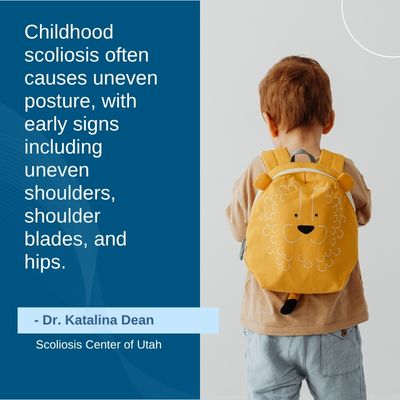 Asymmetrical posture is the main effect of childhood scoliosis, and the earliest changes are often uneven shoulders, uneven shoulder blades, and uneven hips.
So for parents observing a child’s postural changes, it’s not only key to know what to look for, but how to respond appropriately, and the next step is professional assessment to determine if the changes are caused by scoliosis and further diagnostic testing is needed.
If the early signs of scoliosis are missed, because scoliosis is progressive, its nature is to increase in severity, and as signs become more overt, this suggests the scoliosis has been progressing since its onset. Progression makes the spine more rigid and less responsive, and it’s not uncommon for subtle signs to be missed and for childhood scoliosis to progress during growth into young adulthood.
Because progression is triggered by growth, scoliosis can change quickly during growth spurts, so it’s important that treatment is shaped around a child’s age and risk of curve progression.
It’s also important for parents to understand scoliosis risk factors because they can indicate an increasing need for regular early screening.
Scoliosis Risk Factors
Noticing a singular asymmetrical postural change doesn’t guarantee a scoliosis diagnosis, but if there are certain risk factors in place that increase the likelihood of a future diagnosis, early and regular screening is even more important.
As mentioned, scoliosis can affect all ages, but the most common time for scoliosis to develop is around the onset of puberty (adolescent idiopathic scoliosis), so children approaching adolescence should be observed for changes to posture and movement (balance, coordination, and gait).
While female and male adolescents are diagnosed at similar rates, females are significantly more likely to experience rapid curve progression and require a comprehensive treatment plan.
Having a family history of scoliosis is also considered a primary risk factor. Although scoliosis onset hasn’t been traced back to a single scoliosis gene, there may be genetic factors involved, but in general, scoliosis is considered to be more familial than genetic.
Families don’t just share genes, they can also share body type, lifestyle, diet, posture, and more, and for children in families where another child has been diagnosed, siblings should be undergoing regular and early screening.
Idiopathic scoliosis is thought to be multifactorial: caused by a number of variables and/or how those variables combine.
So female children approaching adolescence with a family history of scoliosis are the most at risk and should be regularly screened by a medical professional.
Scoliosis Screening
For parents noticing signs of scoliosis, the next step is scheduling a scoliosis screening exam and can expect a physical examination that includes a postural assessment and an Adam’s forward bend test.
Spinal health and postural health are closely linked, and posture also shapes how we move, so the way a patient holds their body during rest and movement can tell me a lot.
A thorough screening examination should also include giving the patient’s medical and family history, and when a patient bends forward at the hips with the arms hanging neutrally and the fingers pointing down, the spine and related trunk asymmetries are highly visible in this position.
In some cases, the spine’s unnatural curve can be visible, and clinicians are also looking for one shoulder blade sticking out more than the other, the shoulders not sitting at an even height, an arch in the rib cage, and uneven hips where one hip sits higher than the other.
The use of a Scoliometer can also assess a patient’s angle of trunk rotation.
Bodies aren’t always perfectly symmetrical, so if signs of scoliosis are noticed during a screening examination, further testing is needed, and the next step is a scoliosis X-ray.
Diagnosing Scoliosis Early
The only way to rule out, or confirm, the presence of scoliosis is with an X-ray that shows what’s happening in and around the spine.
An X-ray is needed to confirm the presence of an unnatural lateral spinal curve, with vertebral rotation, and the size of the curve (Cobb angle measurement) is also needed to reach a scoliosis diagnosis.
If scoliosis is diagnosed, treatment plans are shaped around the information provided by a patient’s initial scoliosis X-ray so it’s essential that measurements taken are precise and accurate.
An X-ray can also tell us how much rotation there is, the direction of the curve, its location, and a patient’s level of skeletal maturity. Knowing how much growth a child has remaining before reaching skeletal maturity can help predict the amount, and rate, of future curve progression.
The more comprehensive and accurate a patient’s initial scoliosis X-ray, the more detailed and personalized a patient’s treatment plan can be for specific results.
If the early signs of scoliosis don’t go unnoticed and it’s diagnosed while mild, treatment needs are less complex because the curves are smaller and more flexible, but professional assessment is needed to determine whether monitoring, bracing, or scoliosis-specific physical therapy is recommended.
Scoliosis Treatment Options
When curves are small and symptoms are mild, some cases respond to a customized scoliosis-specific exercise plan.
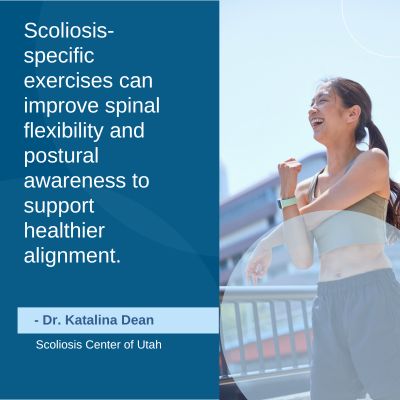 Scoliosis-specific exercise can help increase the spine’s flexibility for more responsiveness, and the use of Mirror Image® exercise focuses on postural awareness and restoration so patients can counteract the spine’s unhealthy position with healthy posture.
ScoliBalance® combines the most current physiotherapy practices with scoliosis-specific chiropractic care.
When curves are larger, less flexible, and progressing, 3-dimensional corrective bracing may be recommended in conjunction with ScoliBalance®.
The ScoliBrace® is a modern corrective scoliosis brace that holds the spine and trunk in a straight and upright position to support its alignment, and the goal is for the brain-body connection to be strengthened to support the spine and body’s improved alignment.
Through integration, scoliosis treatment disciplines can complement one another by working towards the same goal of improving 3-dimensional body posture and the spine’s alignment.
The ScoliBrace® places the spine in an overcorrective position, and because it’s designed to work with exercise-based treatment that can improve the spine’s surrounding muscle strength and balance, the spine’s position and support may be improved.
Conclusion
The goal of early detection is to prevent mild cases from becoming severe, and scoliosis diagnosed as mild can be highly responsive to nonsurgical treatment options.
Parents should understand scoliosis prevalence, risk factors, and early signs to watch for in children.
As a child grows, the effects of scoliosis can increase if progression is occurring, so childhood scoliosis needs to be treated proactively.
The earliest signs to watch for in children are postural changes such as uneven shoulders, a rib cage arch, and uneven hips.
Early treatment for childhood scoliosis may be effective at preventing further curve progression, improving posture, the spine’s alignment, and support from its surrounding muscles.
Concerned parents and caregivers who notice early signs of scoliosis in a child should reach out for professional assessment and guidance so a diagnosis can be reached and treatment-planning can begin.
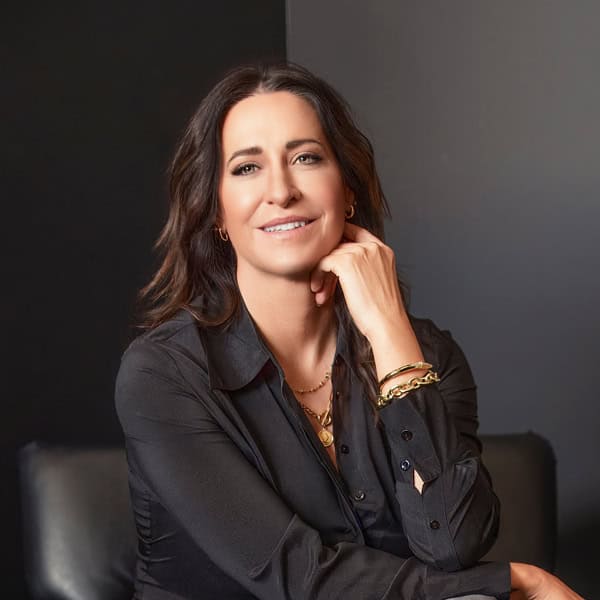
Dr. Katalina Dean
Dr. Katalina Dean is the founder and clinical director of Scoliosis Center of Utah, in Midvale, UT. Her team specializes in posture correction, spinal rehabilitation, and non-invasive scoliosis care and bracing.
Call Today
Do You Qualify for Care?
Schedule an Appointment Below