
Blogs
Can Scoliosis Get Worse with Age?
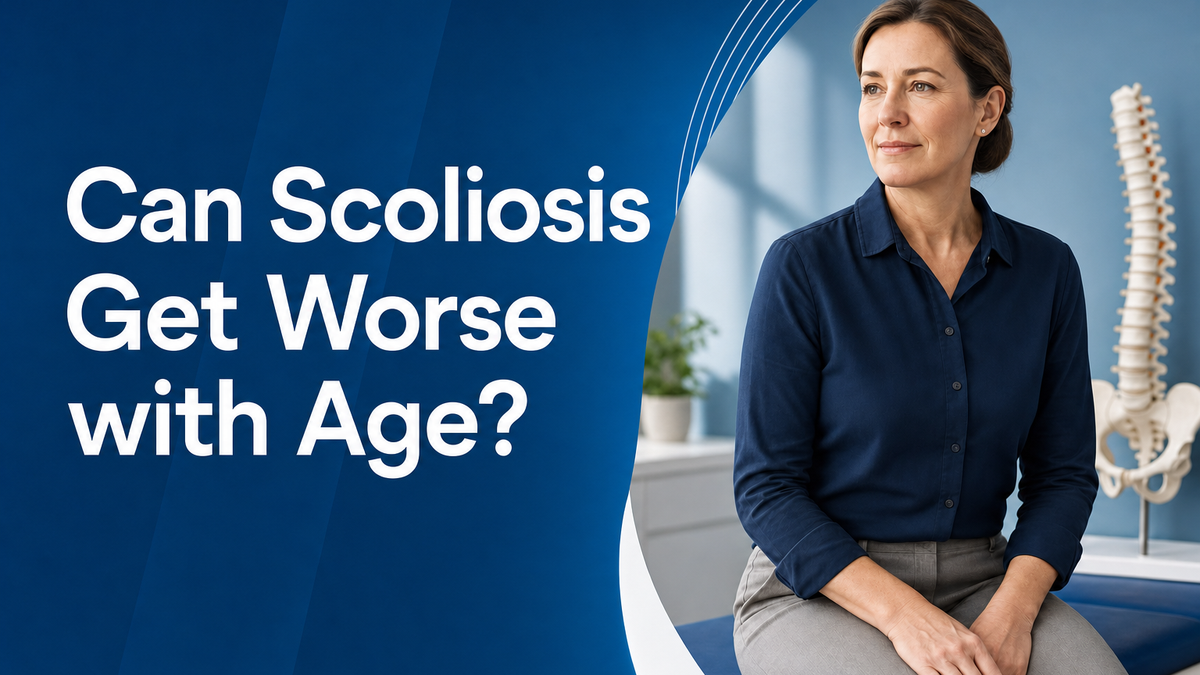
Scoliosis causes the spine to curve and rotate unnaturally and can affect the body in a number of ways. In children, the main symptoms of scoliosis include postural changes, and in adults, it’s pain that typically leads to assessment and diagnosis. Symptoms can increase and become more disruptive over time, particularly in severe and/or untreated cases.
Scoliosis can get worse with age; in fact, as a progressive condition, its nature is to do so, and growth is the main trigger for progression. Scoliosis can also be highly treatable, particularly with early diagnosis and a proactive treatment plan.
In childhood scoliosis, progression is triggered by growth, and in adult onset scoliosis, age-related changes to spinal health can trigger progression.
Being Diagnosed with Scoliosis
Being diagnosed with scoliosis means the spine curves unnaturally to the side and rotates, making it a 3-dimensional condition.
Scoliosis is highly prevalent with almost 7 million people affected in the United States alone, and as the most common spinal condition to affect school-aged children, awareness is needed.
Part of the diagnostic process involves further classifying cases to determine the best course of treatment, and the more detailed and accurate a patient’s initial assessment, the more specific potential treatment results can be.
Being diagnosed with scoliosis means treatment is needed; regardless of scoliosis severity at the time of diagnosis, as a progressive condition, scoliosis can get worse over time.
Scoliosis Progression
With progressive conditions like scoliosis, the timing of treatment is important. There are no treatment guarantees, but the sooner scoliosis is diagnosed, the sooner treatment can be started, and there are a number of benefits associated with early intervention.
Because scoliosis ranges so widely in severity, no two cases are the same. Ranging from mild scoliosis to moderate scoliosis, severe and very severe cases, the goal of a proactive treatment approach is to keep mild cases mild and prevent them from becoming moderate or severe.
Scoliosis affects all ages, but is most commonly diagnosed during adolescence as adolescent idiopathic scoliosis, and because growth is the main trigger for progression, adolescents going through the stage of puberty are the most at risk for rapid curve progression.
Scoliosis progression is triggered by growth in children, but what about when growth stops? Does this mean adult scoliosis doesn’t progress?
Once skeletal maturity is reached, the spine is no longer growing, and this is when scoliosis becomes compressive, and pain caused by compression is the main symptom of adult onset scoliosis.
Adults are no longer growing, but they are vulnerable to age-related degenerative changes in the body and spine that can trigger progression.
Degenerative scoliosis, for example, develops later in life, and because it’s caused by spinal degeneration, increasing instability makes most cases progressive and painful.
 Regardless of age or severity, scoliosis symptoms experienced at the time of diagnosis can change over time.
Scoliosis Symptoms and Curve Progression
We know that as scoliosis progresses, the spine’s unnatural curve size and rotation are increasing, and scoliosis symptoms becoming more noticeable is a sign of progression.
Scoliosis doesn’t just disrupt the spine’s natural alignment and balance; it can disrupt the body’s alignment and balance from the head to the feet.
A healthy spine is necessary for healthy posture, movement patterns, nerve communication, and to structurally anchor the body.
If the spine loses one or more of its natural curves, the spine becomes weaker, less functional, and more vulnerable to injury and uneven wear and tear.
Childhood Scoliosis Progression
In children, the uneven forces of scoliosis cause the development of asymmetrical posture; uneven hips and shoulders are often the earliest telltale signs of scoliosis onset and progression.
As scoliosis progresses, additional postural changes to watch for are uneven shoulder blades, the head appearing uncentered over the torso, rib flaring, an uneven waist line, and arm- and leg-length discrepancy.
Clothes can hang unevenly as scoliosis progresses, and the more posture is disrupted, the more gait, balance, and coordination can also change.
A muscular imbalance is also common as the spine’s surrounding muscles struggle to support and counteract the spine’s unnatural curve and rotation.
Because progression is triggered by growth, children can progress rapidly, and scoliosis that develops in the thoracic spine is the most prone to rapid curve progression.
Although the goal is always to diagnose scoliosis while mild, childhood scoliosis can be the most difficult to detect because it’s not always painful, particularly in mild cases, but small curves are more flexible and simpler to treat.
How childhood scoliosis is treated during periods of rapid growth can shape the spine’s future health.
Adult Scoliosis Progression
While adult scoliosis patients don’t progress as quickly as adolescents, progression can happen slowly over time and increase as changes to spinal health occur.
In fact, the actual rate of scoliosis increases among the aging population due to the onset of degenerative scoliosis.
The two main types of scoliosis to affect adults are adolescent scoliosis in adults (ASA) or degenerative de-novo scoliosis (DDS), and the most prevalent is ASA; this highlights the importance of early detection.
Adolescent scoliosis in adulthood didn’t develop in adulthood, but during adolescence, when the scoliosis wasn’t diagnosed and/or treated. A common scenario is scoliosis going unnoticed during adolescence, but once growth stops, pain from compression occurs, leading to assessment and diagnosis.
In cases of ASA, had these patients been diagnosed and treated proactively during periods of rapid growth, it’s likely they would not have progressed as significantly, and once scoliosis is compressive and the spine is no longer growing, curve rigidity becomes a treatment challenge.
The sooner treatment is started, the better.
Degenerative de-novo scoliosis develops later in life and is caused by spinal degeneration and increasing instability, so progression can occur quickly as there is too much movement within the spine; in these cases, fall prevention is a focus of treatment.
Increasing pain and instability are the main symptoms of adult scoliosis, and scoliosis pain can involve the back, muscles, and pain that radiates into the extremities due to nerve compression.
Scoliosis Progression and Treatment
So as a progressive condition, scoliosis treatment needs are ongoing. Patients need to consider their spine’s long-term health and function when exploring treatment options.
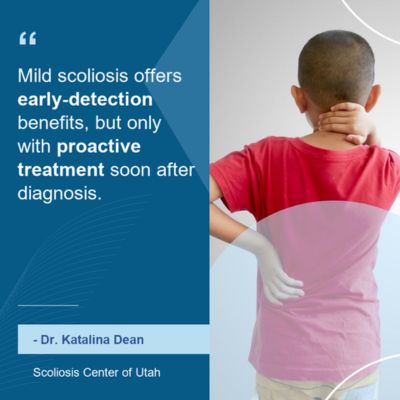 Scoliosis that’s diagnosed while mild has the potential benefits of early detection within reach, but only if a proactive treatment plan is started close to the time of diagnosis.
Particularly in children, counteracting progression during growth is a focus, so the timing of treatment can shape its outcome.
As scoliosis progresses, the spine’s unnatural curve, rotation, and its rigidity are increasing, making it less responsive to treatment.
It’s more difficult to improve the spine’s position when the curve is rigid and the condition’s effects are well-established.
The goal of a proactive treatment approach is to diagnose scoliosis early so treatment can be started when courses are at their mildest, most flexible, and responsive.
Nonsurgical Scoliosis Treatment
Here at the Scoliosis Center of Utah, the goal is restoring the spine’s balance and stability to improve overall body posture and health.
Through combining the potential of multiple scoliosis-specific nonsurgical treatment disciplines, treatment plans can be fully customized.
ScoliBalance® is a scoliosis-specific exercise based approach to scoliosis treatment that customizes exercise recommendations based on a patient’s age, progressive rate, curve type, location, posture, and treatment goals.
Through the use of Mirror Image® exercise, patients are taught postural awareness so the spine’s optimal position is supported by a straight and upright posture.
Patients are taught scoliosis-specific exercises and stretches to strengthen and balance the spine’s surrounding muscles for more support and stability, and when this is applied while the spine is still flexible, positive treatment results are more within reach.
And when combined with the power of a corrective 3D scoliosis brace like ScoliBrace®, and Chiropractic BioPhysics® as an adjunctive treatment, there are fewer limitations to nonsurgical scoliosis treatment.
The main benefit to starting treatment early is counteracting progression, increasing severity, and the need for invasive surgical treatment.
Conclusion
Scoliosis can get worse with age. As a progressive spinal condition, its nature is to increase in severity over time.
In children, it’s growth that triggers progression, and in adults, progression can occur more slowly over time, but in cases of degenerative scoliosis, progression can increase due to the spine’s increasing instability.
Scoliosis ranges from mild scoliosis to moderate and severe scoliosis, and the goal of treatment is to prevent progression.
There are no treatment guarantees, but with early diagnosis and intervention, nonsurgical treatment success is more likely.
Spinal fusion surgery has a place in scoliosis treatment, but in many cases, its necessity can be avoided through a proactive treatment plan that integrates multiple treatment facets working towards a singular goal: improving the spine’s alignment and stability.
So for parents noticing asymmetrical posture in children, and particularly if there is a family history of scoliosis, professional assessment is important, and for patients noticing increasing symptoms, this can be a sign that progression is occurring and treatment needs to be adjusted accordingly.
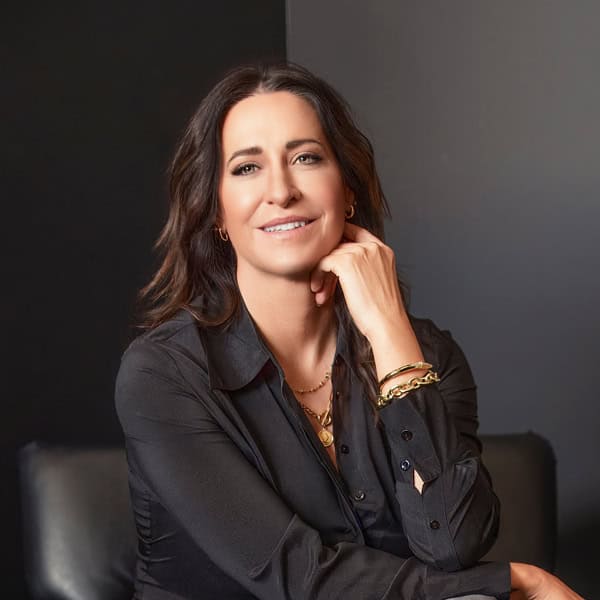
Dr. Katalina Dean
Dr. Katalina Dean is the founder and clinical director of Scoliosis Center of Utah, in Midvale, UT. Her team specializes in posture correction, spinal rehabilitation, and non-invasive scoliosis care and bracing.
Call Today
Do You Qualify for Care?
Schedule an Appointment Below