
Blogs
Screening Test for Scoliosis: A Quick Guide
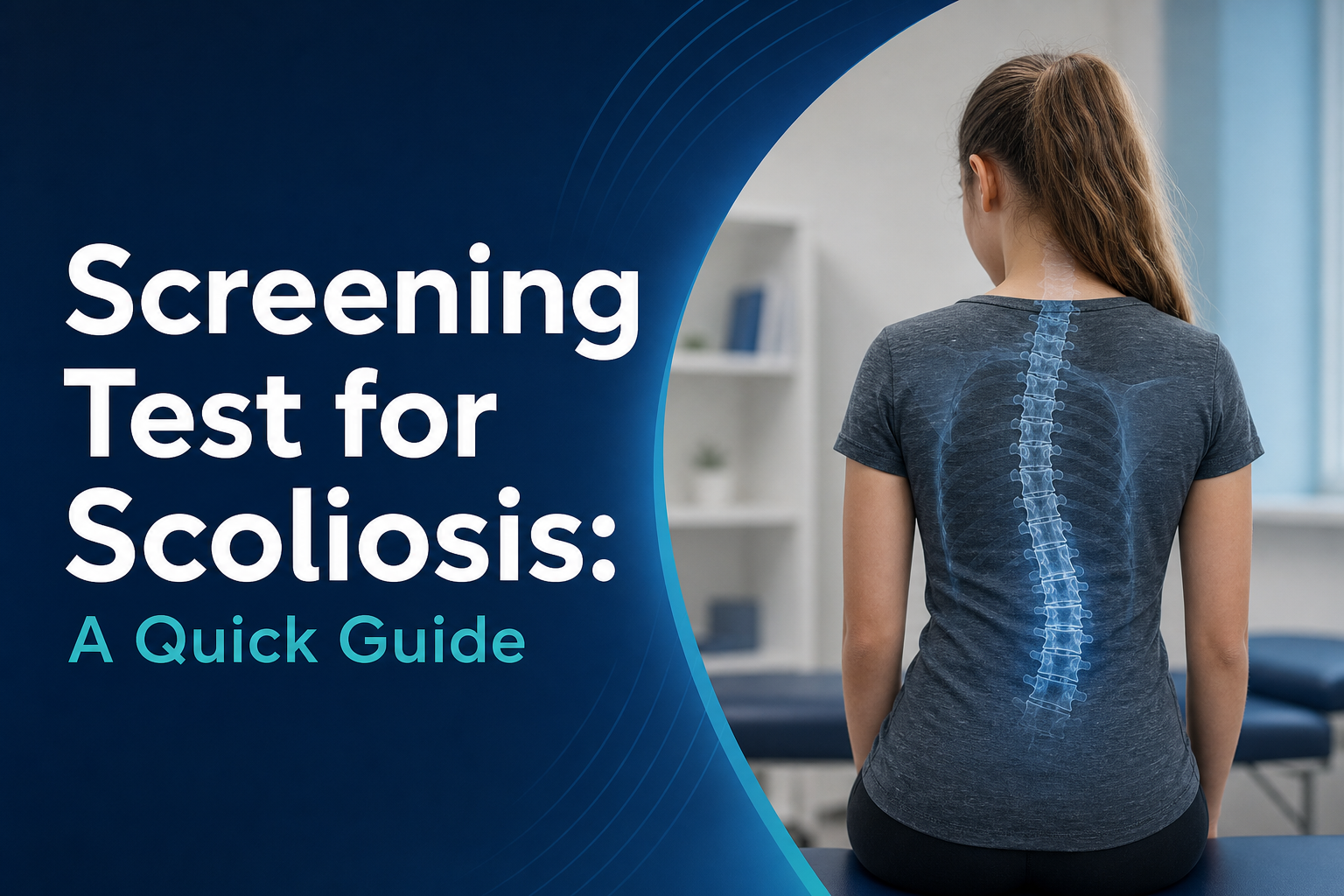
Scoliosis causes unnatural lateral movement of the spine. While a healthy spine will have an S-shape when viewed from either side and will appear flat when viewed from the front and/or back, a scoliotic spine curves to the side and rotates: disrupting its structural integrity.
The only way to definitively confirm the presence of scoliosis is through a scoliosis X-ray, but there are steps beforehand that involve identifying indicators and the need for assessment. From checking for postural changes to an Adam’s forward bend test, awareness of how to check for signs of scoliosis is key.
June is Scoliosis Awareness Month, and with summer approaching, a lot of children will be spending time in bathing suits; this is the ideal time to observe children for postural signs of scoliosis.
The Benefits of Early Detection
Scoliosis is a structural spinal condition that disrupts the spine’s healthy curves, alignment, and stability.
Each of the spine’s main sections has a characteristic healthy curve type, and these curves work together to maintain the spine’s balance, strength, flexibility, shock absorption, and stability.
As a progressive condition, the benefits of early detection involve early intervention. Scoliosis can range from mild to very severe, and because its nature is to worsen over time, it needs to be proactively addressed.
In children, the main trigger for progression is growth, and in older adults, it’s degenerative changes to spinal health, so regular screening for scoliosis in children and adults is important.
When treatment is started early, while curves are mild, the curve is smaller, more flexible, responsive to treatment, and because significant progression hasn’t occurred, the effects of scoliosis are mild and easier to correct.
Scoliosis progressing means the spine’s unnatural lateral curvature and rotation are increasing, and scoliosis effects increase alongside progression, along with increasing spinal rigidity making it harder to improve the spine’s position.
The benefit to early detection of childhood scoliosis is that it can be treated proactively during periods of rapid growth, and when it comes to adult scoliosis, degenerative scoliosis that develops later in life, in particular, can benefit from early detection because increasing instability in the spine can be dangerous.
Degenerative scoliosis patients often exhibit poor posture; leaning too far forward or too far to one side is a main cause of disability in older adults. If this type of postural imbalance is unaddressed, over time, it can initiate a damaging cycle of asymmetric posture, wear, and degeneration.
Screening For Postural Changes in Children and Adults
Childhood scoliosis isn’t always easy to diagnose. Particularly in mild cases, the effects can be subtle and difficult to recognize.
A challenge to early diagnosis of scoliosis in children is that many cases aren’t painful; when growth is occurring, the spine’s being lengthened, and this counteracts pain caused by compression.
As scoliosis develops and progresses, the asymmetrical condition disrupts the body’s overall symmetry and alignment, causing postural deviation, and because progression is triggered by growth, childhood scoliosis can advance rapidly.
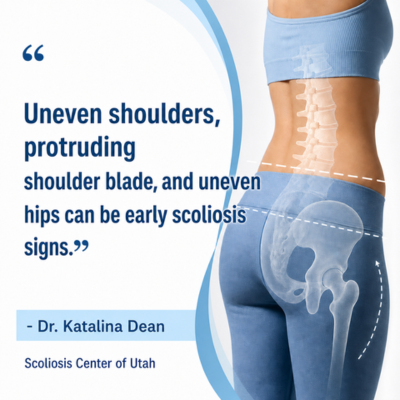 The earliest signs of scoliosis to watch for in children are uneven shoulders, one shoulder blade protruding excessively, and uneven hips.
As childhood scoliosis progresses, the postural changes become more overt and disruptive: the head may appear uncentered over the torso, a rib hump in the rib cage can form, an uneven waistline is common, and arm- and leg-length discrepancy may become noticeable.
As postural changes occur, movement patterns can change too. Changes to balance, coordination, and gait are common as the spine’s misalignment transfers to the body and can be felt from the head to the feet. Restoring balance to the spine means improving the entire body’s stability and health.
If postural changes are noticed in a child, assessment from a scoliosis clinician is recommended, particularly if there is a family history of scoliosis; additional risk factors for scoliosis include age and gender.
Scoliosis is most often diagnosed at the onset of puberty in females, and a little later in males, Females are significantly more likely to progress and require treatment, so female adolescents with a family history of scoliosis are the most at risk.
The goal of diagnosing and starting scoliosis treatment early is preventing progression from mild scoliosis to moderate and severe scoliosis, and the need for invasive surgical treatment.
While scoliosis is more often diagnosed during childhood, adults are also affected, and the actual rate of scoliosis increases among adults over the age of 45 due to degenerative changes in the spine.
Adult Scoliosis
Adults and children experience scoliosis differently. From curve progression to pain, there are some important distinctions when it comes to diagnosing and treating scoliosis in children and adults.
Adults also experience postural changes, but in many cases, it’s pain that leads to assessment and diagnosis. Scoliosis becomes compressive when growth stops, so back and nerve pain are more closely associated with adult scoliosis.
Pain in the extremities is a leading adult scoliosis symptom that alerts adults to the need for assessment.
Early postural changes to watch for in adults include a prominent forward slump, a loss of standing and/or sitting height, back pain, hip pain, leg pain, a prominent lean to one side, and increasing disruptions to balance that can lead to falls.
The two main types of scoliosis to affect adults are idiopathic scoliosis and degenerative de novo scoliosis, and most cases of idiopathic scoliosis in adults are pre-existing from adolescence.
The most prevalent form of scoliosis overall is adolescent idiopathic scoliosis, but if it’s not diagnosed or treated during adolescence, it can progress with time and growth into adulthood, when symptoms and radiating pain increase.
The prevalence of pre-existing idiopathic scoliosis in adults highlights the importance of early detection. While it’s never too late to start treatment, by the time these adults receive a diagnosis and treatment, their spines are rigid, and curve flexibility is a factor that shapes treatment outcome.
Unlike idiopathic adult scoliosis, degenerative de novo scoliosis develops later in life with no prior history.
Adam’s forward bend test
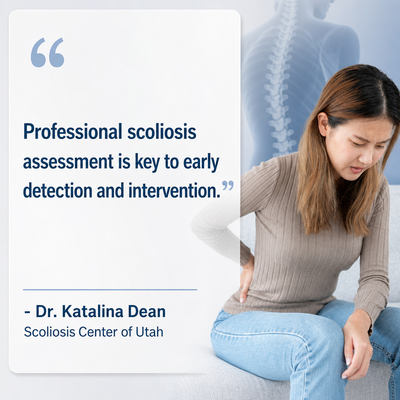 Nothing can replace professional assessment performed by an experienced scoliosis clinician, but of course, recognizing the need for professional assessment is the first step towards early detection and intervention.
An Adam’s forward bend test is the leading scoliosis screening examination performed in clinics, hospitals, doctor’s offices, and homes; it’s a simple noninvasive method for identifying potential indicators of scoliosis.
An Adam’s forward bend test can easily be performed at home to regularly screen for early signs of scoliosis, and professional assessment also involves a forward bend test.
With the feet together and knees straight, having a child bend forward at the hips with the arms hanging neutrally at the side and fingers pointing down puts the spine and torso in a highly-visible position.
In this position, a noticeable arch in the lower or upper back can be visible, along with related trunk asymmetries (uneven shoulders, hips, rib flaring).
If a parent notices a hump in the back and/or imperfect posture, this doesn’t guarantee a scoliosis diagnosis, but it does indicate the need for further testing and professional assessment.
When scoliosis clinicians notice indicators of scoliosis, an X-ray is needed to confirm, or rule out, the presence of an unnatural lateral spinal curvature with rotation.
Conclusion
There are approximately seven million people living with scoliosis in the United States, and as the most common spinal condition to affect school-aged children, scoliosis screening is important.
School screening exams for scoliosis used to be common, but the onus of early detection now rests primarily on the shoulders of parents and patients themselves.
When there is a family history of scoliosis, the likelihood of another diagnosis in the family increases, so regular early screening for scoliosis is recommended prior to children entering puberty; there are benefits associated with starting treatment prior to significant growth spurts of puberty.
For children, early intervention is crucial due to growth triggering progression, and in adults, early intervention is important because once the spine starts to degenerate, a damaging cycle is initiated that can be difficult to disrupt, placing adults at risk of injury due to increasing instability.
The Scoliosis Center of Utah treats scoliosis proactively and nonsurgically. Through improvement to the spine’s alignment, body posture, and the spine’s surrounding muscle strength and balance for uniform support, the spine and body’s overall balance and stability can be improved.
If you’re concerned a child or adult in your life is showing signs of scoliosis, there are resources available including a home screening tool, but nothing is as reliable as a screening examination performed by an experienced scoliosis clinician, and a scoliosis X-ray is necessary for diagnosing scoliosis.
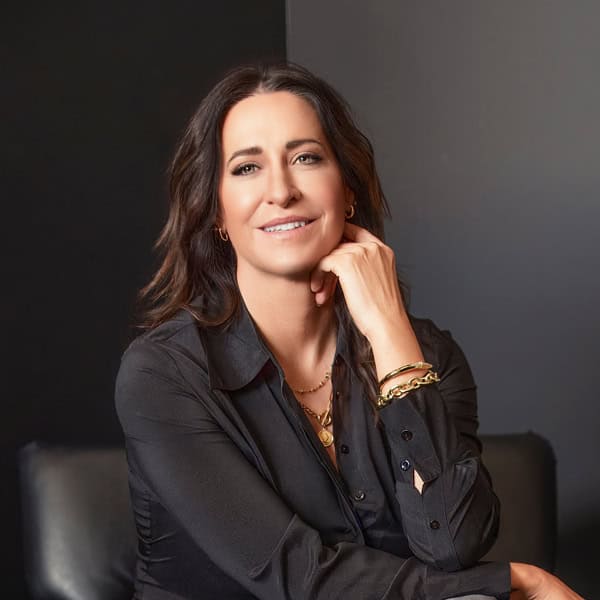
Dr. Katalina Dean
Dr. Katalina Dean is the founder and clinical director of Scoliosis Center of Utah, in Midvale, UT. Her team specializes in posture correction, spinal rehabilitation, and non-invasive scoliosis care and bracing.
Call Today
Do You Qualify for Care?
Schedule an Appointment Below