
Blogs
Minor Scoliosis Symptoms: Early Signs to Watch

Mild scoliosis can cause minor symptoms that are subtle and not always disruptive, but as a progressive condition, the nature of scoliosis is to change over time. Recognizing the early signs of scoliosis can ease a patient’s journey by starting treatment when curves are small, flexible, and can be highly responsive.
The earliest signs of mild scoliosis in children involve asymmetrical changes to body posture like uneven shoulders and hips, and in adults, it’s often back pain that indicates the need for assessment. When treatment is started early, there is more time to discuss, observe, and plan treatment.
Mild scoliosis can require a different treatment approach than moderate and severe cases.
Minor Scoliosis Symptoms
Scoliosis disrupts the spine’s healthy position by curving to the side and rotating, and although the early signs can be mild, with early diagnosis and an individualized treatment plan, increasing severity may be preventable.
Scoliosis can affect all ages and affects children and adults differently. The earliest signs of childhood scoliosis are postural changes.
While asymmetrical posture doesn’t guarantee a diagnosis of scoliosis, uneven shoulders, one shoulder blade sticking out, rib flaring, and one hip sitting higher are common signs that should be assessed by a medical professional.
The earliest sign of scoliosis in adults is lower back pain, followed by radiating pain in the extremities caused by nerve compression, and in general, adult scoliosis is more painful than childhood scoliosis because the condition becomes compressive when skeletal maturity is reached. And degenerative scoliosis that affects older adults is almost always progressive and painful because it’s caused by degenerative instability.
Recognizing the early signs of degenerative scoliosis such as leaning too far forward or to the side and lower back pain can mean disrupting the cycle of poor posture, uneven weight distribution, and degeneration that can cause further complications.
Minor scoliosis symptoms can be mild, but with curve progression, cases of mild scoliosis can become moderate or severe scoliosis, and if symptoms are increasing and becoming more noticeable, the scoliosis may be advancing, and treatment needs are becoming more complex.
For parents and caregivers noticing the above signs in a child, the next step is to have an experienced scoliosis clinician assess the patient and determine whether an X-ray is needed.
Minor Scoliosis Screening
The goal of scoliosis education is early detection. If some asymmetrical postural changes are noticed in a child, the next step is professional assessment to check for more signs of scoliosis.
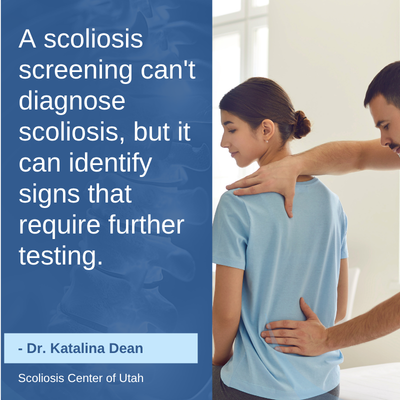 While a scoliosis screening exam can’t diagnose scoliosis, it can look for signs of scoliosis that indicate the need for further testing.
Most screening examinations will involve taking a patient’s family history and observing posture and gait. I can tell a lot about a patient’s spinal health by how they hold their body during rest and movement.
Patients can also expect an Adam’s forward bend test that involves bending forward at the hips with arms hanging neutrally at the sides and fingers pointing down; in this position, the spine and trunk are highly visible.
An unnatural curvature may be more visible in this position, along with postural changes involving the trunk such as uneven shoulder height, one shoulder blade protruding more, an arch in the rib cage, and uneven hips.
A Scoliometer may also be used to assess the spine’s rotation. If a screening examination finds indicators of scoliosis, a scoliosis X-ray is the only way to reach a scoliosis diagnosis.
Scoliosis affects all ages but is most often diagnosed in adolescents (adolescent idiopathic scoliosis) at the onset of puberty, and when it comes to early detection, being aware of the early signs of scoliosis is important, along with understanding the role of risk factors.
Scoliosis Risk Factors
Because scoliosis is so common and is the main spinal condition affecting school-aged children, all children should be regularly watched and/or screened for early signs of scoliosis, and there are certain risk factors that increase the likelihood of a diagnosis.
In addition, scoliosis is progressive, and the main trigger for progression of childhood scoliosis is growth, and in adults, it’s age-related and/or lifestyle-related degenerative changes to spinal health.
If there are known risk factors in place, early and regular scoliosis screening is even more important, and having a family history is considered a primary risk factor.
Although scoliosis isn’t classified as a genetic condition, it does have genetic components, and having a child in the family with scoliosis does mean siblings are more likely to develop scoliosis.
Idiopathic scoliosis is the most common type of scoliosis, with no known cause, and is thought to be multifactorial, and in general, scoliosis is considered to be more familial than genetic.
Scoliosis runs in families, but remember, families don’t just share genes; they can share body type, diet, lifestyle, posture, socioeconomic factors, responses to stress, etc.
Because scoliosis is most often diagnosed at the onset of puberty in females and a little later in males, as children are approaching adolescence, they should be watched and screened for early signs of mild scoliosis.
Gender is another risk factor as females are significantly more likely to experience curve progression and require comprehensive treatment, so girls approaching puberty with a family history of scoliosis are the most at risk.
There are no treatment guarantees, but when scoliosis is diagnosed while mild, the unnatural spinal curve is smaller, more flexible, and may be highly treatable.
Mild Scoliosis Treatment Options
Scoliosis patients need to be aware of all treatment options available to them so professional guidance is important.
Mild scoliosis symptoms can become more noticeable if progression is happening. 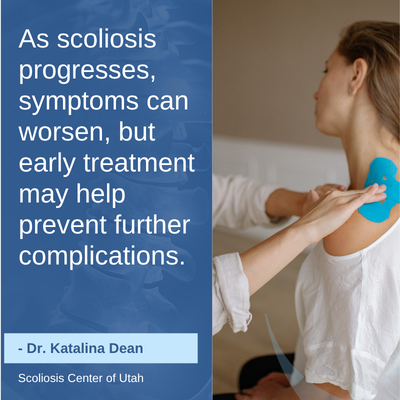 If the spine’s unnatural curve and rotation is increasing, the effects can become more disruptive, but when treatment is started early, increasing symptoms and further complications may be preventable.
A proactive treatment plan is needed to manage childhood scoliosis during rapid growth, and while patients need individual assessment and personalized treatment plans, starting treatment early is associated with scoliosis treatment success.
Progression causes the spine to become more rigid and can make it less responsive to changes in position. Flexibility of the curve when treatment is started is an outcome-shaping factor.
The goal of mild scoliosis treatment is to prevent it from becoming moderate scoliosis or severe scoliosis, to prevent increasing symptoms, and the need for surgical treatment in the future.
Treatment planning is based on the results of imaging tests that tell me what I need to know about a patient’s scoliosis: type, curve location, curve size (Cobb angle), flexibility, angle of trunk rotation, and stage of skeletal maturity.
Conservative Treatment
Some cases of mild scoliosis with small flexible curves respond to a scoliosis-specific exercise based program alone, but in most cases of adolescent scoliosis, due to the risk of curve progression, a combination of scoliosis-specific physical therapy and 3D bracing is recommended.
Through scoliosis-specific exercise, posture can be improved, along with the spine’s alignment and flexibility, and targeted exercise focuses on increasing the strength and balance of the spine’s surrounding muscles for more support/stability.
The power of 3D bracing is that it maintains the spine and torso’s straight position while retraining the connection between the brain and the body’s new healthy upright posture, and when combined with scoliosis-specific exercise, the spine’s support and stability are also being increased through improvements to the spine’s surrounding muscle health.
A mild curve may be correctable with the right treatment plan, and while a primary care provider can help screen for signs of scoliosis, a trained scoliosis clinician is needed to craft a scoliosis-specific treatment plan for specific results.
Conclusion
Symptoms of scoliosis can be subtle, particularly in cases of mild scoliosis, but knowing the early warning signs can help.
In children, the earliest signs of scoliosis are often uneven shoulders and uneven hips, and in adults, it’s scoliosis pain in the lower back and nerve pain.
When the signs of scoliosis are noticed early, professional assessment is needed to determine if further testing is warranted, and when treatment options are individualized and nonsurgical, body posture and the spine’s health may be improved through changes to its position and level of support.
In cases of mild scoliosis symptoms increasing, this is a sign that progression is happening, and the best way to prevent further progression and manage symptoms is through a proactive conservative treatment plan combining the potential of scoliosis-specific physical therapy and corrective 3D bracing.
For young patients showing signs of scoliosis, the timing of treatment is crucial, and reaching out for professional assessment can set young patients on the path of early diagnosis and a successful treatment outcome.
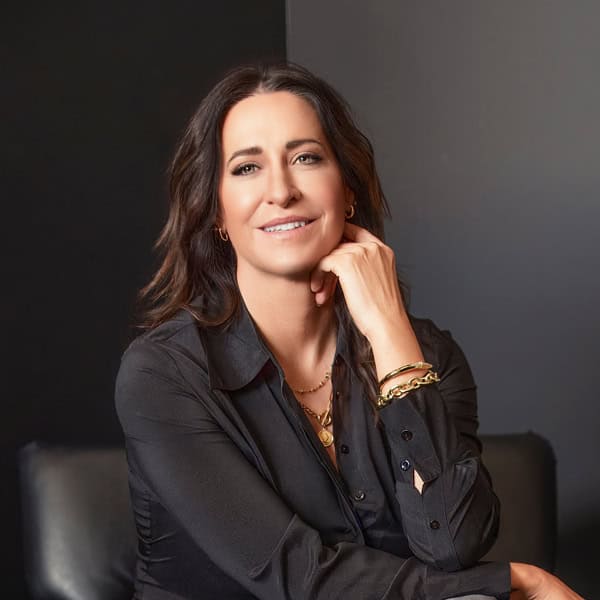
Dr. Katalina Dean
Dr. Katalina Dean is the founder and clinical director of Scoliosis Center of Utah, in Midvale, UT. Her team specializes in posture correction, spinal rehabilitation, and non-invasive scoliosis care and bracing.
Call Today
Do You Qualify for Care?
Schedule an Appointment Below