
Blogs
Weight Training with Scoliosis: Safe Exercises to Try
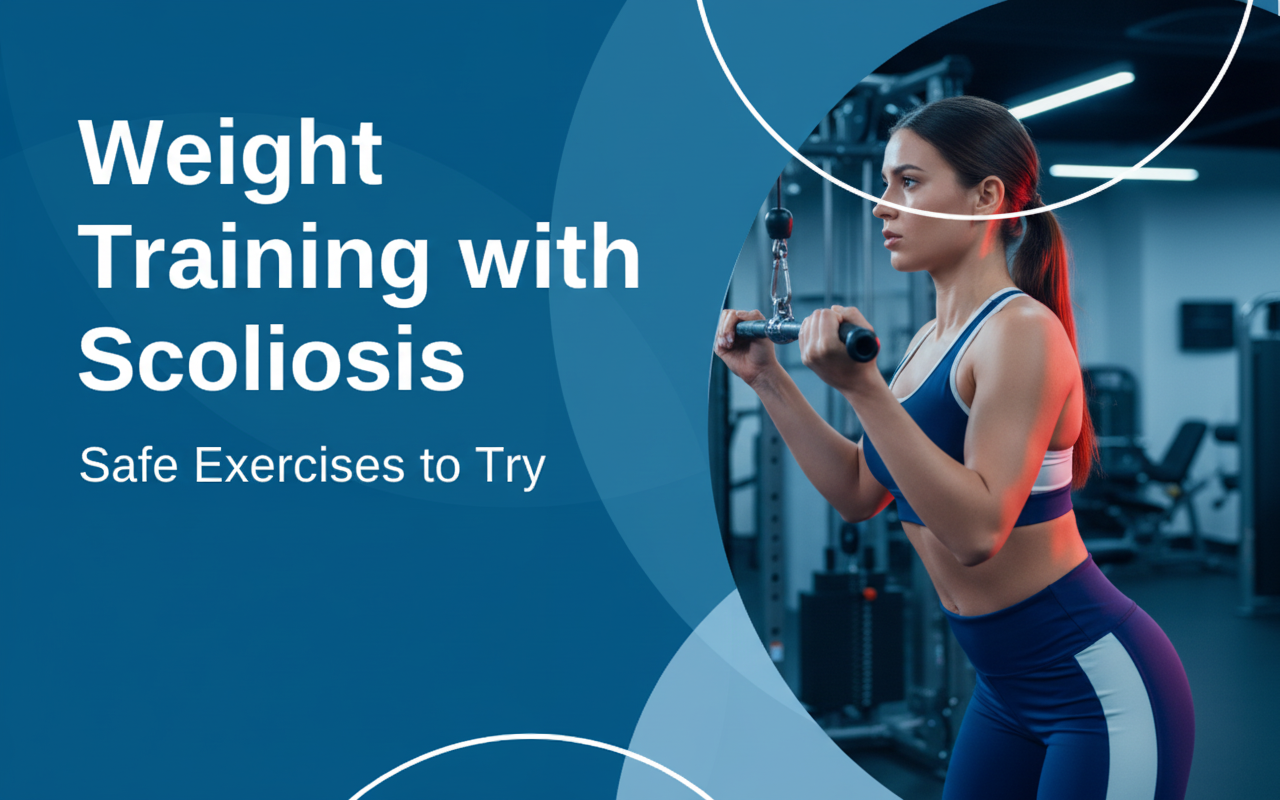
Lifting weights can have a number of benefits for people with scoliosis including increasing bone density, core strengthening for more spinal support and stability, and pain relief. All exercise has to be approved by a patient’s scoliosis treatment provider, but in general, direct lifting of heavy weights straight over the head isn’t recommended.
When it comes to weight training with scoliosis, there are a number of benefits to increasing core strength and overall strength training, but there are also risks involved. Proper form is important, as is working with a professional, and avoiding exercise that increases spinal compression is key.
For people with scoliosis, exercise is important, but there are certain exercises that need to be approved, approached with caution, and/or avoided completely.
Exercising with Scoliosis
Scoliosis is a complex condition that causes the spine to develop an unnatural curve that bends to the side and rotates.
As a progressive condition, the nature of scoliosis is to increase in severity over time, and while there is a lot we still don’t know about idiopathic scoliosis etiology, we know growth is the main trigger for progression.
So it’s important to understand that where a patient’s scoliosis is at the time of diagnosis doesn’t indicate that’s where it will stay; a proactive treatment plan is needed to counteract progression in most cases.
When it comes to exercising with scoliosis, activity recommendations/restrictions are case specific, so patients need to have all exercises and activities approved by their treatment provider to ensure an exercise is safe for an individual’s specific scoliosis and curve type and that it won’t interfere with treatment or exacerbate symptoms.
Scoliosis is an asymmetrical condition that causes the development of asymmetrical posture and unhealthy movement patterns as a result, and a scoliotic spine is weaker, more vulnerable to injury, and in patients who are no longer growing, it’s a compressive condition.
Compression is uneven and excessive pressure, and the goal of any scoliosis-friendly exercise plan is to increase core strength for optimal spinal support and stability for the spine without straining the spine or its surrounding muscles.
Weight bearing exercise can help manage scoliosis symptoms, strengthen core and back muscles, and improve spinal stability, but caution is important.
Benefits of Weight Training for Scoliosis Patients
It’s important for everyone to cultivate a healthy activity level, but for people with scoliosis, it can have some extra benefits; regular exercise can help increase spinal flexibility, making the spine more responsive to treatment, reducing pain, increasing bone density, and a strong core and back supports the spine’s proper alignment.
In fact, scoliosis-specific exercise and physical therapy is a key facet of nonsurgical scoliosis treatment, but it does need to be designed by a scoliosis specialist and combined with additional treatment disciplines to facilitate correction.
Pain Relief
Weight training can help manage scoliosis symptoms. While scoliosis is not painful for everyone, particularly once growth stops and scoliosis becomes compressive, back and nerve pain can become disruptive.
As scoliosis progresses, the spine’s rigidity increases, and this can cause back and muscle pain, and weight training that’s guided by a scoliosis-specific physical therapist can help maintain the spine’s flexibility and strength.
 As muscle imbalances and muscle soreness is common in scoliosis patients, targeted weight training can work towards improving the spine’s surrounding muscle balance and strength for more spinal support and less pressure on the spine.
Spinal Support and Stability
It’s not just the spine that maintains proper spinal alignment, but also the core and back muscles.
Increasing core and back-muscle strength through resistance training can mean more support and stability for the spine, and a strong core supports healthy posture, and good posture supports healthy movement patterns.
While postural deviation caused by an unnatural spinal curve also needs to be addressed through impacting the underlying structural nature of scoliosis, strengthening muscles that support and stabilize the spine through weight bearing exercise can also help with fall prevention in older adults.
Postural Alignment
Postural health and spinal health can’t be separated. How we hold our spines and body during movement and rest can have long-term cumulative effects on spinal health and function.
Over time, chronic poor posture can strain the spine and its supportive structures, and if muscles and ligaments that support the spine become stretched, over time, this can contribute to a lack of spinal support and the development of an unhealthy curve.
A misaligned body can lead to a misaligned spine and vice versa. A strong core supports straight and upright posture, which means the spine is also held in a straight and neutral alignment.
Weight training can increase core strength; a strong core supports healthy posture, and proper posture supports the spine’s alignment.
Safe Weight Training Exercises for Scoliosis Patients
Remember, all forms of exercise need to be approved by a scoliosis patient’s treatment provider, and working with a scoliosis-specific physical therapist to determine which particular type of weight lifting has the most to offer is important.
There are different types of weight training from powerlifting and strength training to body building, circuit training, isometric training, functional training, and endurance training.
 When it comes to scoliosis, the focus of weight training should be on increasing postural alignment, improving muscle imbalances, and muscle strengthening for more support.
If a muscular imbalance is an issue, unilateral strength training can help increase the strength of weaker muscles without overdeveloping overused muscles, so single targeted one-armed dumbbell rolls and single-arm overhead presses can help with strengthening weak and/or unbalanced muscles.
Weight-bearing functional exercises improve strength and mobility and can include lunging and squatting with weights. Core strength training that incorporates movement can also strengthen joints and support healthy movement patterns.
Controlled movement while lifting weights is important; lifting and lowering weights in a controlled and deliberate manner helps maintain spinal alignment and limits the risk of injury.
Weight lifting with high-compression loads should be avoided, particularly when it comes to deadlifting weights straight above the head; this is a lot of weight to add to the spine and its supportive structures and can strain the spine and/or its surrounding muscles.
Lifting weights with a scoliosis-specific physical therapist or personal trainer is important to ensure proper form is maintained, and working out in front of a mirror can help with postural awareness and restoration.
It’s also recommended that scoliosis patients use machines and dumbbells for improved stability and precise controlled movements, versus strength training with heavy barbells.
Conclusion
Weight lifting with scoliosis can offer patients a number of health benefits, but it also comes with risks, so the first step to developing a healthy weight-lifting routine is consulting with a professional.
It’s important for scoliosis patients to be aware of proper form, prioritize core strength training, avoid high compression, and to stop if pain and discomfort are felt as the exercise may be too strenuous.
Scoliosis ranges widely in severity from mild to severe, and each cause is unique, including activity recommendations/restrictions, so while weight training may be restricted for some patients, it can be deemed safe for others.
Scoliosis patients need to be aware of form, work out in front of a mirror for postural awareness, and focus on core strength.
When performed properly and safely and approved by a scoliosis patient’s treatment provider, potential benefits include increasing spinal flexibility, core strength, pain relief, and improved spinal support for more stability.
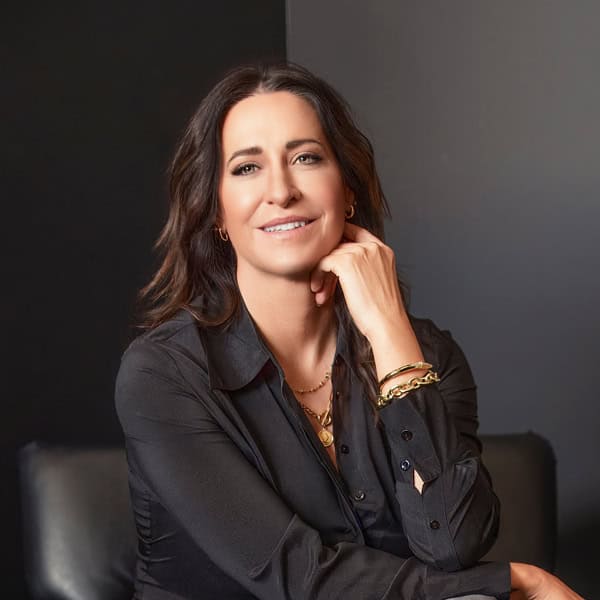
Dr. Katalina Dean
Dr. Katalina Dean is the founder and clinical director of Scoliosis Center of Utah, in Midvale, UT. Her team specializes in posture correction, spinal rehabilitation, and non-invasive scoliosis care and bracing.
Call Today
Do You Qualify for Care?
Schedule an Appointment Below