
Blogs
Scoliosis Exercises to Avoid: Protect Your Spine
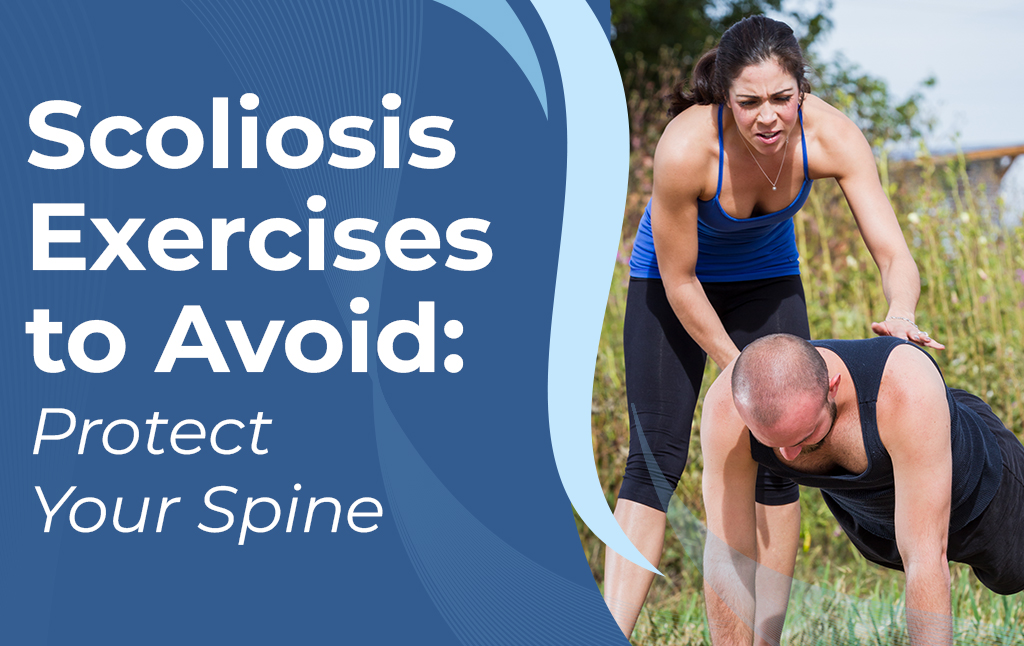
When it comes to exercising with scoliosis, there are a number of potential benefits, but there are also risks involved. When scoliosis-specific and combined with other types of treatment, exercise can have corrective potential, but scoliosis patients need to be careful and have exercise approved by their scoliosis treatment provider.
People with scoliosis can benefit from safe and approved exercise, but there are certain exercises to avoid. Protecting a scoliotic spine is important because it’s more vulnerable to strain and injury. Exercises to avoid are those that exacerbate muscle imbalance, further compress the spine, and/or place the spine in an unnatural position.
Activity restrictions for scoliosis patients are case-specific; awareness of which exercises and activities are deemed safe, which should be approached with caution, or avoided completely is important.
Protecting a Scoliotic Spine
Protecting a scoliotic spine means preserving its strength and function, cultivating a healthy activity level that doesn’t strain the spine and/or interfere with treatment, and addressing the condition with treatment.
 Scoliosis causes the spine to develop an unnatural lateral spinal curve that rotates, meaning it doesn’t just bend unnaturally to the side, but also twists, and this exposes the spine, its surrounding muscles and nerves, and the entire body to uneven forces.
The goal of treatment plans is to restore as much of the spine’s healthy curves as possible, improving the spine’s alignment, strength, function, and the body’s overall symmetry and alignment.
If the spine doesn’t have its healthy curves in place, its vertebrae are misaligned, and if the spine is not balanced and stable, the body can be misaligned from the head to the feet.
And because scoliosis is a progressive condition, its nature is to get worse over time, and as it’s growth that triggers progression, how scoliosis is managed during periods of rapid growth is crucial.
Protecting a scoliotic spine also means knowing the types of exercise that are safe and unsafe, and while activity restrictions will vary from person to person, the following types of exercise are often deemed unsafe for people with scoliosis.
Muscular Imbalance and Scoliosis
As scoliosis introduces uneven forces to the spine and body, its main effect is disrupting the body’s overall symmetry.
In many cases, the earliest signs of scoliosis in children are uneven shoulders and hips, and additional postural deviation can include:
- The head appearing uncentered over the torso
- Uneven shoulder blades
- Development of an arch in the rib cage
- Arm- and leg-length discrepancy
And the larger the size of the unnatural spinal curve, and the more rotation there is, the more severe the condition, and the more noticeable its effects are going to be; patients with severe scoliosis are also more likely to experience activity restrictions.
The uneven forces of scoliosis doesn’t just affect the spine, but also its surrounding muscles; a common effect of scoliosis is muscular imbalance, so when it comes to scoliosis exercises to avoid, those that exacerbate the condition’s asymmetrical effects, including muscle imbalances, should be avoided.
A muscular imbalance can develop due to the spine’s unnatural bend and twist pulling its surrounding muscles in different directions. Muscles on one side of the spine can become strained and tight from straining to counteract the spine’s unnatural pull and twist, and muscles on the opposite side can become weak from lack of use.
Exercises and activities that overuse one side of the body can further exacerbate the condition’s asymmetrical effects so activities like tennis, bowling, and golf should be avoided; a focus of nonsurgical scoliosis treatment is on restoring muscle symmetry and knowing the types of activities that don’t work the body’s muscles symmetrically is important.
Scoliosis-specific exercise treatment plans will include corrective exercises that, among other things, works towards improving the strength and balance of the spine’s surrounding muscles for more support and stability.
Compression and Scoliosis
Compression is uneven and/or excessive pressure, and once skeletal maturity has been reached, scoliosis becomes a compressive condition.
Growing spines are constantly being lengthened, which counteracts the compressive force of the scoliosis, but once growth stops, compression-related pain is the main symptom of adult scoliosis that leads to a diagnosis.
A scoliotic spine is already facing compression, so exercises to avoid include those that increase compression: squatting with weights, dead lifting weight straight over the head, and push ups that can strain the spine.
Lifting weights straight over the head increases weight and pressure on the spine, its vertebrae, and intervertebral discs.
 Particularly with poor form and heavy loads, dead lifting with scoliosis can be risky because there’s potential to further disrupt the strength and balance of the spine’s surrounding muscles, strain the spine, increase progression, and/or pain.
The Spine’s Position
A healthy spine will have its natural curves in place and its vertebrae aligned, holding the spine in a straight and neutral position, but scoliosis disrupts the spine’s healthy position and alignment, so activities and exercises that place the spine in an unnatural position and/or involve hyperextension should be approached with caution and/or avoided entirely.
If the spine has an unnatural curve and twist, it needs to have its position improved, and this means working towards realigning the spine.
Posture shapes spinal health, and spinal health is shaped by posture, so the spine and body’s position are interconnected.
Activities like ballet and gymnastics are commonly not recommended for people with scoliosis due to the hyperextension pushing the vertebrae further out of alignment and into rotation.
Some swimming maneuvers and yoga poses are also not recommended for scoliosis patients due to the risk of flattening out the curve and placing unnatural pressure on already-strained joints, vertebrae, and discs.
In addition, activities and exercise that involve repeated jarring motions can also increase compression so should be avoided (horseback riding, football,
While it’s important to be mindful of activity restrictions and recommendations, the best way to protect a scoliotic spine is to treat the condition proactively.
Scoliosis Treatment
When it comes to restoring the spine’s strength, balance, and stability, this is the best means of minimizing activity restrictions.
Scoliosis is progressive, and there are no treatment guarantees, but it can be highly treatable, particularly with early detection and intervention.
Scoliosis ranges widely in severity from mild to moderate and severe scoliosis, and the more progression occurs, the more posture and mobility are going to be disrupted, and the more caution is needed when approaching certain exercises/sports/activities.
When scoliosis is diagnosed while mild and treated while mild, the spine is still flexible and highly responsive, and as significant progression hasn’t occurred, condition effects aren’t overt and/or well-established.
Mild scoliosis is simpler to treat, and while the designation of mild can sound as though there is a lack of urgency when it comes to treatment, it’s quite the opposite; the best time to start scoliosis treatment, with the most potential for a successful outcome, is while cases are still mild.
Here at the Scoliosis Center of Utah, the focus is on customizing proactive nonsurgical treatment plans with the goal of restoring the spine and body’s balance and stability.
There was a time when the place of exercise in scoliosis treatment was questioned, but we know that increasing spinal flexibility, muscle strength and balance, through the power of scoliosis-specific exercise is at the center of nonsurgical scoliosis treatment.
Combining the potential of Chiropractic BioPhysics to improve the spine’s position and alignment, scoliosis-specific rehabilitative exercise to strengthen and balance the spine’s surrounding muscles, and corrective 3-dimensional bracing to further improve the spine’s position and body posture, can impact scoliosis on multiple levels for long-term sustainable treatment results.
Conclusion
Knowing which types of exercise are deemed safe for scoliosis patients and which should be avoided is important for protecting a scoliotic spine.
As scoliosis causes the spine to bend and twist unnaturally, it’s more vulnerable to strain an injury.
While activity recommendations/restrictions will be case-specific, in general, exercise that overuses one side of the body, introduces more compression, and/or places the spine in an unnatural position should be avoided.
When it comes to protecting a scoliotic spine, the most important factor is how a diagnosis is responded to with treatment because as a progressive condition, treatment needs are ongoing and can shape the spine’s long-term strength and function.
A proactive and customized conservative treatment plan that combines the power of scoliosis-specific chiropractic care, physical therapy, and corrective bracing can offer corrective potential, and the chances of success increase the sooner treatment is started.
Dr. Katalina Dean
Dr. Katalina Dean is the founder and clinical director of Scoliosis Center of Utah, in Midvale, UT. Her team specializes in posture correction, spinal rehabilitation, and non-invasive scoliosis care and bracing.
Call Today
Do You Qualify for Care?
Schedule an Appointment Below