
Blogs
Levoscoliosis of Lumbar Spine: Causes & Treatment
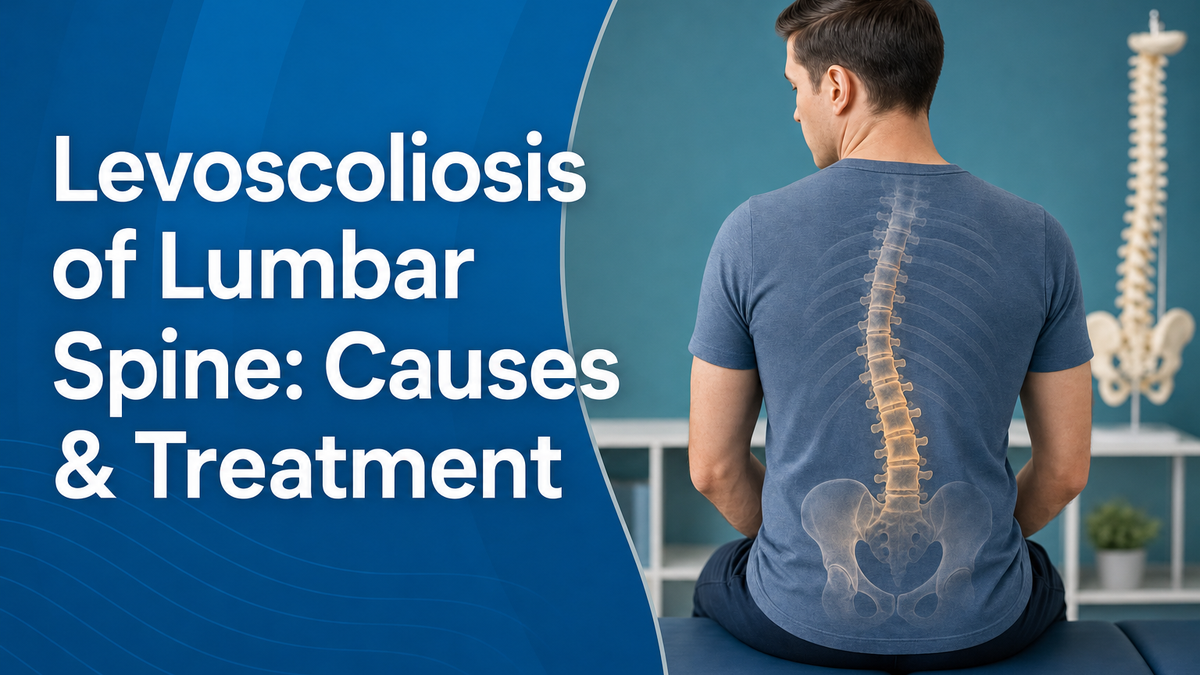
The lumbar spine supports upper body weight, facilitates a wide range of motion, protects the spinal cord, and feels the effects of strenuous lifts, bends, and twists. When scoliosis develops in the lumbar spine, it can cause pelvic obliquity, poor posture, changes to movement, and lower back pain.
A diagnosis of levoscoliosis of the lumbar spine means the lumbar spine (lower back) has developed an unhealthy sideways curvature with rotation. Scoliosis is a spinal condition, but its effects aren’t isolated to the spine alone, and scoliosis that’s left untreated can cause increasing effects.
Levoscoliosis
Scoliosis treatment plans need to be fully customized because no two cases are the same.
Scoliosis causes the spine to curve unnaturally to the side and rotate, and the rotational component makes it a complex 3-dimensional condition.
Levoscoliosis causes the spine to bend to the left (levoscoliosis), while most typical cases of scoliosis involve right-bending curves.
Right-bending curves (dextroscoliosis) are curving away from the heart; left-bending curves are curving towards the heart.
Scoliosis also affects all ages. It’s most commonly diagnosed during adolescence as adolescent idiopathic scoliosis, but it also affects adults, and the actual rate of scoliosis increases among the aging population.
Ranging widely in severity, scoliosis can be diagnosed as mild, moderate, severe, or very severe, and all levels benefit from treatment.
There are also different types of scoliosis with unique causes, varying treatment needs, and different curve patterns.
Levoscoliosis Causes
When scoliosis is diagnosed, it’s comprehensively assessed and further classified based on a number of important variables.
Patient age is important because it indicates the potential level of progression; growth is the main trigger for progression in children, so the more growth a patient has remaining prior to reaching skeletal maturity, the more likely curve progression is.
In most cases of scoliosis, approximately 80 percent, the cause is idiopathic: no single-known cause.
The remaining types of scoliosis are associated with known causes such as neuromuscular scoliosis caused by the presence of an underlying neuromuscular disease (cerebral palsy, spinal bifida, muscular dystrophy) and degenerative de novo scoliosis that develops later in life.
Idiopathic scoliosis can involve left-bending curves, and the cause is unknown, and while neuromuscular scoliosis can involve left-bending curves, it’s most common in older adults with degenerative scoliosis.
Degenerative Scoliosis
The two main types of scoliosis to affect adults are idiopathic scoliosis and degenerative scoliosis that develops later in life with no prior history.
Cases of idiopathic scoliosis in adulthood are most often pre-existing from adolescence; these cases were undiagnosed and untreated, progressing with time and growth into adulthood, and as scoliosis becomes compressive when growth stops, this is when compressive pain can lead to assessment and diagnosis.
When scoliosis develops later in life, often over the age of 45, and is caused by degenerative instability, it’s diagnosed as degenerative scoliosis.
The lumbar spine is the most common spinal section affected by degenerative scoliosis and has a lot of responsibilities; its vertebrae are the strongest and largest due to their load-bearing nature.
The lumbar spine feels the effect of bends, lifts, and twists that, over time, can strain the spine, and if poor posture is occurring, the degenerative cycle can be initiated due to asymmetric loading and degeneration.
 Postural collapse is a leading cause of disability in older adults, and because degenerative scoliosis is caused by increasing degenerative instability, most cases are progressive and painful.
Lower back pain is the main complaint, and because the spine is unstable, risk of injury through a fall is a concern.
Degenerative Changes in the Lumbar Vertebrae
Degenerative scoliosis is caused by the spine becoming increasingly unstable over time; usually, this happens slowly as the degenerative cycle is initiated and becomes more established the longer it’s left unaddressed.
In most cases of degenerative changes to spinal health, the degeneration starts with the intervertebral discs.
A disc sits between adjacent vertebrae and performs many essential functions: gives the spine structure, flexibility, provides cushioning to prevent friction during movement, and acts as the spine’s shock absorbers.
If a disc is degenerating, it can lose fluid, change shape, and affect the position of attached vertebrae, and because the discs provide the spine with structural support, degeneration can compromise the spine’s structural integrity, causing too much movement within the spine.
While the spine’s design is movement-based, too much movement causes instability and is problematic.
Chronic poor posture can damage spinal health, and poor spinal health can cause unhealthy posture. The way we hold our bodies during movement and rest can cumulatively shape spinal health over time by the types of forces the spine’s exposed to.
 Degenerative levoscoliosis can progress up to 4 degrees a year once the degenerative cycle is in place, so the goal is early detection; the instability needs to be addressed to prevent further degenerative changes, damage, and injury.
So levoscoliosis of the lumbar spine is commonly caused by the lower back becoming increasingly unstable, and due to its weight-bearing nature, the lower back is particularly vulnerable to degenerative changes and the effects of poor posture.
Lumbar Levoscoliosis Treatment Options
Here at the Scoliosis Center of Utah, the power of posture is valued. Postural awareness and correction is a focus of the Center’s scoliosis treatment approach.
In order to sustain treatment results and lead a spine-friendly lifestyle, postural improvements are crucial.
As an asymmetrical spinal condition, a primary effect of scoliosis is postural deviation; among children, the earliest signs of scoliosis are uneven shoulders and uneven hips.
In aging adults, as muscles and supportive ligaments can stretch and weaken, it becomes harder to resist the downward pull of gravity, and posture can suffer.
Postural Restoration
Leaning too far forward or too far to one side introduces uneven pressure to the spine, its discs, facet joints, and the spine’s surroundings, and over time, if the imbalance is unaddressed, the lack of uniformity will cause uneven wear and degeneration.
The more posture is disrupted, the more healthy movement patterns are disrupted, and the longer it’s left unaddressed, the more unstable the spine becomes.
Treatment for degenerative scoliosis is customized and proactive; the goal is to preserve spinal function, improve spinal alignment, support, stability, and balance for fall prevention.
Nonsurgical Treatment Options
Through advanced and specialized scoliosis-specific chiropractic care (Chiropractic BioPhysics®), improving the spine’s position is the focus of gentle and precise manual adjustments that target the curve’s most unnaturally-tilted vertebrae.
ScoliBalance® is a scoliosis-specific rehabilitative exercise-based approach to treatment that’s evidence-based and can help improve the spine’s surrounding muscle strength/balance for uniform support and stability.
A strong core supports healthy posture, and postural improvement is the key to degenerative scoliosis treatment success. Mirror Image® exercise is a valuable tool used to teach postural awareness so patients can recognize when their posture is poor and correct it.
Healthy posture helps sustain curve corrections and reduces the uneven forces exposed to the spine and its surroundings. A straight and upright torso supports the spine’s optimal alignment.
Scoliosis-specific exercise can also increase spinal flexibility for treatment responsiveness and pain relief.
When necessary, corrective bracing can also help by maintaining the torso’s upright position, curve correction through spinal coupling, and retraining the connection between the brain and the body’s new healthier 3D posture and alignment.
Conclusion
Levoscoliosis of the lumbar spine means an unnatural spinal curve with rotation has developed in the lower back, and the curve bends to the left.
Typically, scoliosis curves bend to the right, away from the heart, and levoscoliosis of the lumbar spine can be idiopathic, caused by the presence of an underlying medical condition (neuromuscular scoliosis), or increasing degenerative instability (degenerative scoliosis).
Degenerative scoliosis affects older adults and is caused by degenerative changes to spinal health. It’s important for patients to understand that the cumulative effect of lifestyle factors affects a person’s rate, and severity, of spinal degeneration.
Carrying excess weight puts extra pressure on the spine and is associated with poor posture. Leading a sedentary lifestyle can damage disc health and contribute to a weak core and back, and the spine needs to be surrounded by strong muscles for support and stability.
Chronic poor posture is linked to a number of health problems, one of which is initiating the degenerative cycle of asymmetric loading and degeneration, and once this cycle is initiated, it can be difficult to slow and/or reverse.
When it comes to making improvements to the spine’s stability and balance, it’s never too late to start treatment; even incremental improvements to posture and/or spinal health can impact quality of life.
Dr. Katalina Dean
Dr. Katalina Dean is the founder and clinical director of Scoliosis Center of Utah, in Midvale, UT. Her team specializes in posture correction, spinal rehabilitation, and non-invasive scoliosis care and bracing.
Call Today
Do You Qualify for Care?
Schedule an Appointment Below