
Blogs
Exercises for Kyphosis: Improve Posture and Mobility
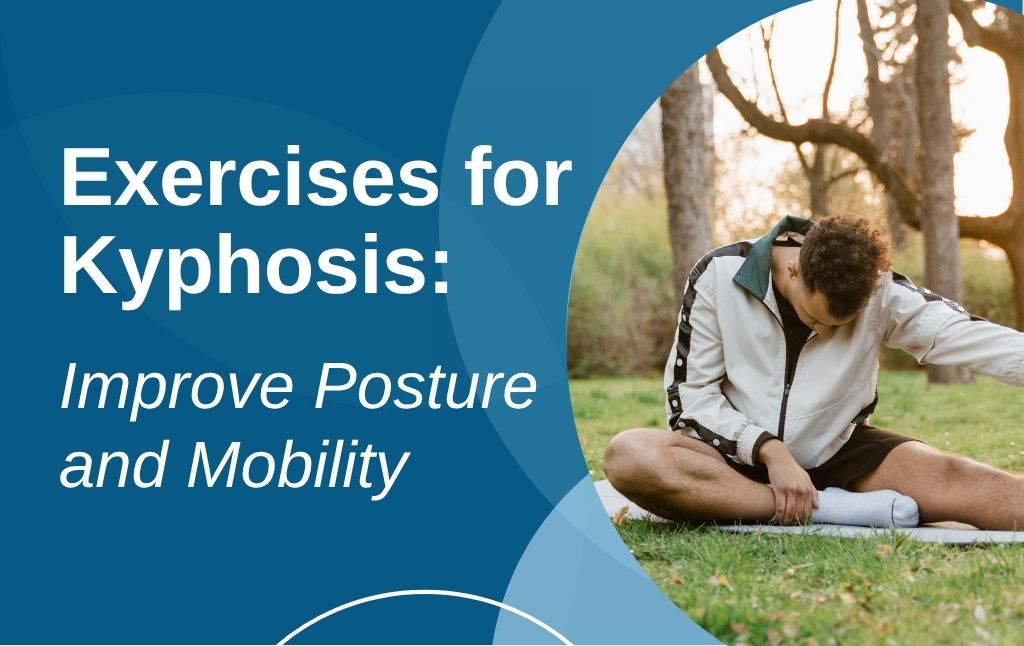
ScoliBalance® is a customized exercise program used to treat scoliosis and kyphosis in children and adults. It’s a complete care approach involving therapists, chiropractors, and physical therapists working together to recommend kyphosis-specific exercise plans based on a patient’s curve type, posture, symptoms, and treatment goals.
If the thoracic spine’s kyphosis increases and becomes excessive, treatment to improve posture and mobility may be recommended. A customized exercise program for kyphosis helps manage progression, increase spinal flexibility, muscle strength and balance, improve posture, curve size, balance, and pain. Kyphosis exercise may also increase bracing efficacy.
Exercises for kyphosis are individualized and taught to patients for sustainable treatment results and long-term improvement to spinal health.
Helpful Exercises for Kyphosis
Helpful exercises for kyphosis are approved by a patient’s treatment provider, personalized to address the specifics of a patient’s curve, and support symptom relief and curve correction.
Here at the Scoliosis Center of Utah, experienced ScoliBalance® clinicians help patients recognize the many factors that can contribute to an unhealthy spinal curve, such as poor posture and muscle health. Patients are taught how to counteract the spine’s forward-rounding with straight and upright posture.
Exercises for kyphosis should offer symptom relief through stretching tight chest muscles, strengthening weak and unbalanced muscles, and improving the spine’s range of motion, but they may also increase treatment responsiveness, manage progression, reduce curve size, improve the spine’s support and stability, and in patients recommended for bracing, exercise and modern bracing complement one another for better results.
So while kyphosis exercises are customized to each patient and need to be approved by treatment providers, the following exercises and stretches are often recommended as part of a kyphosis-specific exercise plan.
Thoracic Extension on a Foam Roller
Thoracic extension with a foam roller may help counteract the thoracic spine’s excessive kyphosis by mobilizing the upper back stretching tight chest muscles to relieve stiffness, and to establish a more upright and neutral posture.
To perform a thoracic extension on a foam roller:
- Place the foam roller horizontally on the floor and sit in front of it
- Then lie on your back with the roller positioned under the thoracic spine (below the neck and above the rib cage)
- Support the head with your hands and gently arch the back over the roller until a comfortable stretch is felt
- Hold the position, return to starting position, and repeat approximately 10 – 15 times based on personal recommendations
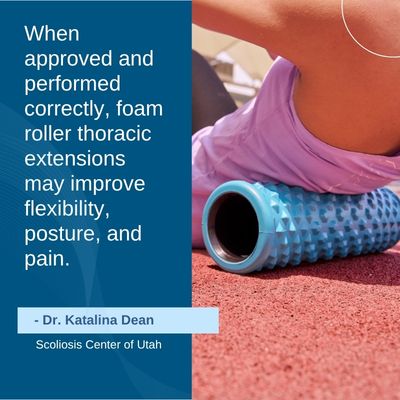 When approved by a treatment provider and performed correctly, thoracic extensions with a foam roller may help improve the upper back’s flexibility for pain relief and better posture.
Scapular Squeezes
Scapular squeezes target the rhomboids and middle trapezius muscles of the upper back and can counteract the forward rounded shoulders caused by too much kyphosis.
To perform a scapular squeeze:
- Sit or stand with the arms neutrally at the sides
- Focus on the shoulders blades and squeeze them together in a downward pull and backward motion
- Hold the squeeze for a few seconds and release
- Repeat approximately 10-15 times based on personal recommendations
Scapular squeezes support upper back muscle endurance, muscle pain relief, and help open up the chest (helpful for patients experiencing breathing difficulties).
Cat-Cow Stretch
The cat-cow stretch can be helpful for kyphosis by gently mobilizing the middle/upper back, relieving pain, improving mobility, and improving posture.
To perform a cat-cow stretch:
- Start in a tabletop position (on the hands and knees with spine parallel to the floor)
- Inhale slowly and arch the back into a cow position by lifting the head and tailbone towards the ceiling
- Then exhale slowly while rounding the back into a cat position by tucking the chin and tailbone
- Repeat approximately 10 – 15 times based on personal recommendations
The cat-cow stretch focuses on the power of mindful movement and intentional breathing which also supports healthy posture and body awareness.
Planking
Planking supports deep core strength and activates postural muscles that help stabilize the spine and may prevent the curve from worsening. Planking engages muscles symmetrically for balance, muscle endurance, and improved posture.
To plank:
- The starting position is a push-up position with the hands aligned with the shoulders
- Maintain the body’s straight line from the head to the heels and the spine should be neutral and parallel to the floor
- Engage the core and maintain the position
Hold the pose for approximately 20-30 seconds based on personal recommendations and ability
When performed properly and consistently, planking supports spinal endurance, muscle endurance, muscle balance, core stability, and body awareness.
Why is Kyphosis Problematic?
The two main types of spinal curves are lordosis and kyphosis. Lordosis refers to the spine’s inward curvature found in the cervical and lumbar spinal sections, and kyphosis refers to the thoracic spine’s outward curve.
Kyphosis can range in size, and if it falls within a typical range, the curve may be healthy, but if the curve increases and becomes excessive, a number of issues may develop. There are different factors that determine whether a person’s kyphosis is problematic or not including age, but typically, a healthy thoracic kyphosis is 44 degrees, with a kyphosis-degree of 50+ considered excessive. If a thoracic kyphosis is over 55 degrees, then exercises alone can not change the shape of the disc/spine. You will need an outside force like a kyphosis brace or 2- point bending traction to reshape the spine and proper exercise to realign the spine into a healthy 44-degree thoracic kyphosis curve. Maintaining this curve is critical for long-term health such as lung, heart, digestive function, mobility, balance, and overall support.
Too much kyphosis can cause chronic back pain, poor posture, weak muscles, breathing issues, digestive issues, nerve compression, and patients with too much kyphosis may also be at a higher risk of compression fractures.
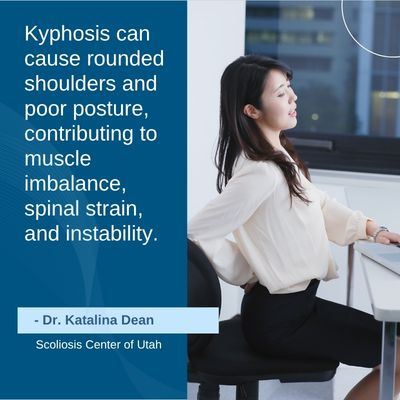 Kyphosis causes noticeably-rounded shoulders and a slouching posture that, over time, can contribute to muscle imbalance and place unnecessary strain on the spine and its individual structures, and uneven strain can cause uneven wear and increasing instability with age.
The spine’s curves balance each other out to maintain its balance and stability, but if the middle/upper back curves outward excessively, the spine’s overall health and function may be disputed.
When it comes to treatment planning for kyphosis, individual assessment is necessary to determine the type of kyphosis and measure the curve accurately. Treatment options to improve kyphosis include kyphosis-specific exercises, chiropractic care, and in some cases, bracing is recommended.
Kyphosis Type and Severity
Before recommending specific exercises to improve posture and kyphosis, the underlying cause needs to be determined along with curve characteristics such as severity and flexibility.
Different types of kyphosis include postural kyphosis, Scheuermann’s kyphosis, and age-related kyphosis.
Postural kyphosis is caused by chronic poor posture contributing to weak back muscles, stretched ligaments, and a lack of support for the spine. The curve isn’t structural so it’s flexible and easier to correct. Recommendations for lifestyle modification, postural improvement, and targeted exercise to build core and back muscle strength are common.
Scheuermann’s kyphosis is linked to uneven vertebral growth. Curves are structural and rigid so require a more comprehensive treatment plan to impact the curve and restore posture. Treatment recommendations may include Chiropractic BioPhysics® Mirror Image exercise to teach postural awareness and correction, kyphosis-specific rehabilitative exercise to build core strength and balance muscles for more support and stability for the spine, increased flexibility for treatment responsiveness, and to complement corrective bracing as a treatment option.
Age-related kyphosis affects older adults and involves the spine’s supportive muscles and ligaments weakening over time, and in patients experiencing low bone density, increasing kyphotic pressure can cause compression fractures and wedge-shaped vertebrae. Because increasing instability is a concern, fall prevention strategies are important, and actively treating the imbalance with kyphosis exercise and bracing are common recommendations for older adults.
Conclusion
The spine’s curves shape its overall health, but spinal curves can change over time and are affected by a number of factors. If a person’s thoracic kyphosis increases to the point of becoming excessive, it can cause a number of symptoms including pain, stiffness, reduced mobility, and poor posture.
Posture shapes spinal health over time, so it’s important to maintain healthy posture as we age, and our core strength and stability are necessary components of proper posture.
Exercises for kyphosis are customized around the specifics of a patient’s curve, symptoms, and treatment goals, so need to be designed by an experienced clinician and approved by a patient’s treatment provider.
Exercises such as thoracic extensions, scapula squeezes, the cat-cow stretch, and planking support core strength, muscle balance, pain relief, mobility, and healthy posture, and when combined with additional facets of treatment such as bracing and chiropractic care, a healthy range of kyphosis may be further supported.
If you have noticed an excessive rounding forward of the upper back and shoulders, it’s possible that kyphosis is increasing and becoming problematic. An individual assessment can determine whether further testing is needed, what the next steps should be, and make informed treatment recommendations.
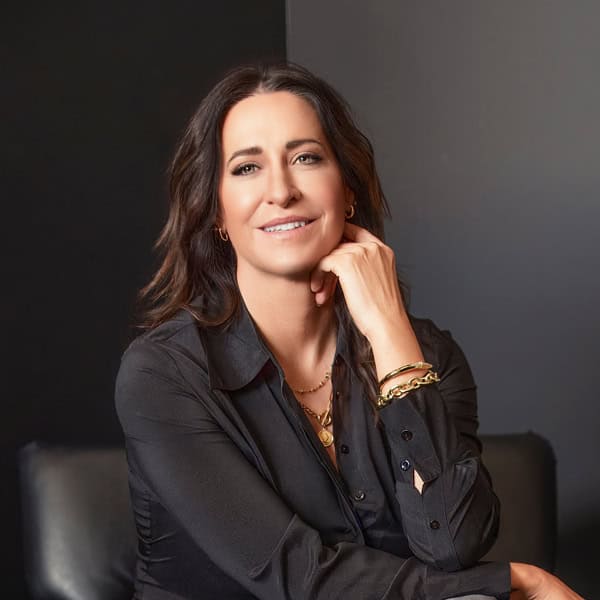
Dr. Katalina Dean
Dr. Katalina Dean is the founder and clinical director of Scoliosis Center of Utah, in Midvale, UT. Her team specializes in posture correction, spinal rehabilitation, and non-invasive scoliosis care and bracing.
Call Today
Do You Qualify for Care?
Schedule an Appointment Below