
Blogs
Can Poor Posture Cause Chest Tightness?
Chronic poor posture can cause a number of issues from organ dysfunction to disc degeneration, headaches, fatigue, back, shoulder, neck, and chest pain. Unfortunately, our modern tech-heavy world is seeing an increase in postural imbalances and related health issues, due in part to how much time is spent looking down at devices and/or slumped over a desk.
Poor posture may cause chest pain by contributing to weak and unbalanced muscles, excessive pressure on the rib cage, and/or compressing nerves. Over time, chronic poor posture may also change the position and health of the spine, and a misaligned spine can also cause chest pain.
How we maintain the body’s position during daily activity shapes the type of forces it’s exposed to, and as we age, postural awareness becomes more important.
Poor Posture and Chest Pain
Poor posture can contribute to chest tightness and discomfort by affecting muscle health, the position of the rib cage, blood flow, and nerve health.
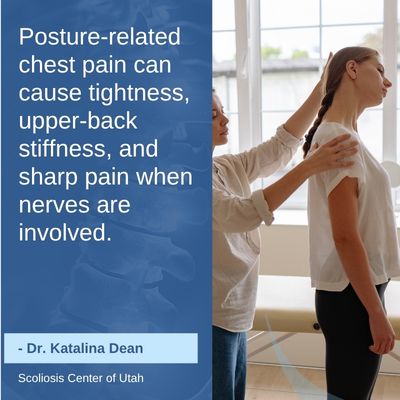 Chest pain caused by unhealthy posture can involve feelings of tightness that increase when inhaling deeply, stiffness and discomfort in the upper back and shoulders, and if nerves are involved, sharp shooting pains may also develop.
Poor Posture and Muscle Health
Poor posture can affect muscle health through introducing uneven forces that cause strain and imbalance. If a slouching posture develops, chest muscles can become tight, and over time, can shorten, further contributing to a cycle of improper posture and poor muscle health.
And the muscles that sit between the ribs and facilitate breathing can also become strained and sore due to improper posture compressing the intercostal muscles.
If a rounded-forward posture is causing tight pectoral muscles and strains the intercostal muscles, a dull ache and feelings of tightness across the chest may develop, along with sharp pains when inhaling deeply.
Muscles that are worked too much become tight and short, and muscles that are not being stimulated can become weak and long. While a muscular imbalance can cause a number of localized effects, it can also cause widespread symptoms as the asymmetry shapes how the body moves and wears over time.
Balanced and strong back and core muscles are needed to support healthy posture, respiration, and the spine’s healthy position.
Posture and The Rib Cage
If the upper body is not aligned and balanced, the position and function of the rib cage may be affected.
The thoracic spine (the largest spinal section) attaches directly to the rib cage to form the thoracic cage. If the thoracic spine is strained due to poor posture, it can affect the position and health of the rib cage. A primary role of the thoracic cage is to protect the lungs and heart.
As mentioned, poor posture can affect lung function by impacting the health of the intercostal muscles (primary muscles used in breathing) between the ribs, potentially causing rib dysfunctions.
Straining the small muscles that support breathing may also stress joints because if there is a lack of support from surrounding muscles, the joints have to work harder to support healthy movement and stability.
If lung expansion is limited, this may also affect the heart as it has to work harder to transport oxygen, potentially contributing to heart related chest pain.
The lungs need space to function optimally. They need room to inhale and exhale deeply, and if poor posture is causing a loss of space within the chest region, difficulty breathing and feelings of tightness in the chest may develop.
Posture and Nerve Health
The spinal cord contains 31 pairs of spinal nerves that exit the spine and project throughout the body, and because posture is shaped by a number of complex networks, poor posture has the potential to impact a number of systems, including the central nervous system (CNS).
A primary role of each spinal section is to protect the spinal cord for nerve health and function, and if chronic slouching is exposing the thoracic spine to uneven forces, nerve health may be affected due to compression, and chest discomfort may develop.
Most nerve compression involves the nerve root, where nerves exit the spine, and if the body’s unnatural positioning is applying excessive and/or uneven pressure to a nerve, it can cause pain signals and discomfort felt along the nerve’s pathway, which depending on the nerve affected, may be extensive.
Nerve health also depends on healthy blood flow, and the body’s alignment shapes how blood flows throughout. Balanced and healthy posture keeps blood flowing freely. Chronic slouching or sitting incorrectly for extended periods of time can involve blood trapped in the legs, restricting blood flow, which may also strain the heart.
 If nerve compression is occurring due to bad posture, affected nerves can’t communicate properly with surrounding muscles, further contributing to muscle tension and weakness, and bad posture can also disrupt spinal health in a number of ways.
Poor Posture and Spinal Health
If the body is held in an unnatural position, so is the spine, and the effects of poor posture habits, over time, can disrupt the spine’s alignment, balance, and overall health. If the thoracic spine, in particular, (middle/upper back) is being impacted negatively, varying degrees of back and/or chest pain may develop.
The spine needs to be held in a straight, neutral, and upright position to function optimally.
If the spine is surrounded by weak and/or unbalanced muscles related to poor posture, the lack of support can make it harder for the spine to maintain its healthy curves and balance, and strained back and chest muscles can cause chest pain and tightness.
Poor posture habits can also cause uneven weight distribution. If someone is slouching and rounded shoulders happen, upper body weight isn’t evenly distributed over the pelvis, and if mechanical stress can’t be transferred down the centre of the pelvis and lower body evenly, unhealthy movement patterns may develop.
If the spine becomes misaligned, its individual structures, such as intervertebral discs and facet joints, can wear unevenly, contributing to the spine’s increasing instability and chest pain.
The Importance of Healthy Posture
The importance of healthy posture can’t be underestimated. Proper posture is based on a number of complex networks working together. The musculoskeletal system (muscles and bones), the nervous system (body’s communication network), and the vestibular system (orients the body’s position and supports balance) all play a role.
Healthy posture helps resist the downward pull of gravity, which becomes increasingly beneficial among the aging population, and supports the spine’s stability for fall prevention.
The longer poor posture is left unaddressed, the more established uneconomical movement patterns may become and the harder they can be to reverse, and particularly in older adults, if a vicious cycle of poor posture, asymmetric loading, and wear is initiated, it can cause increasing disruptions to balance and spinal stability; early detection and intervention are crucial.
Posture related chest and back pain is a common challenge for older adults, and because poor posture can introduce constant tension to muscles, nerves, and the spine, it can affect a person’s overall health and quality of life.
Poor posture can affect muscle health, breathing, how nerves function/communicate with muscles, and the spine’s alignment, but with postural awareness and restoration, improvements may be within reach.
Conclusion
If you are experiencing back and/or chest pain, timely assessment by a medical professional can help identify contributing factors.
Poor posture can cause chest pain and tightness by contributing to poor muscle health, impacting the rib cage and lung function, nerve health, and spinal alignment.
For sustainable long-term relief, the root cause of the chest pain needs to be determined, understood, and addressed, and poor posture is a common contributor to back and chest pain, particularly among older adults.
In some cases, patients are simply unaware of the damage they are causing, and lifestyle adjustments may help. However, when chronic poor posture has been in place for years and has affected the position and health of the spine, a broader treatment plan may be needed.
Combining lifestyle modifications, education on the importance of proper posture, physical therapy, and chiropractic care may relieve muscle tension, improve muscle imbalances, restore proper blood flow, open up the chest for improved lung function, reduce nerve compression, and improve the spine’s position and health.
If you’re experiencing posture related chest pain, don’t hesitate to reach out for assessment; in many cases, with clinical guidance, postural restoration provides chest pain relief while offering a number of additional health benefits.

Dr. Katalina Dean
Dr. Katalina Dean is the founder and clinical director of Scoliosis Center of Utah, in Midvale, UT. Her team specializes in posture correction, spinal rehabilitation, and non-invasive scoliosis care and bracing.
Call Today
Do You Qualify for Care?
Schedule an Appointment Below