
Blogs
Can Chiropractic Care Fix Scoliosis or Support Scoliosis-Specific Treatment?
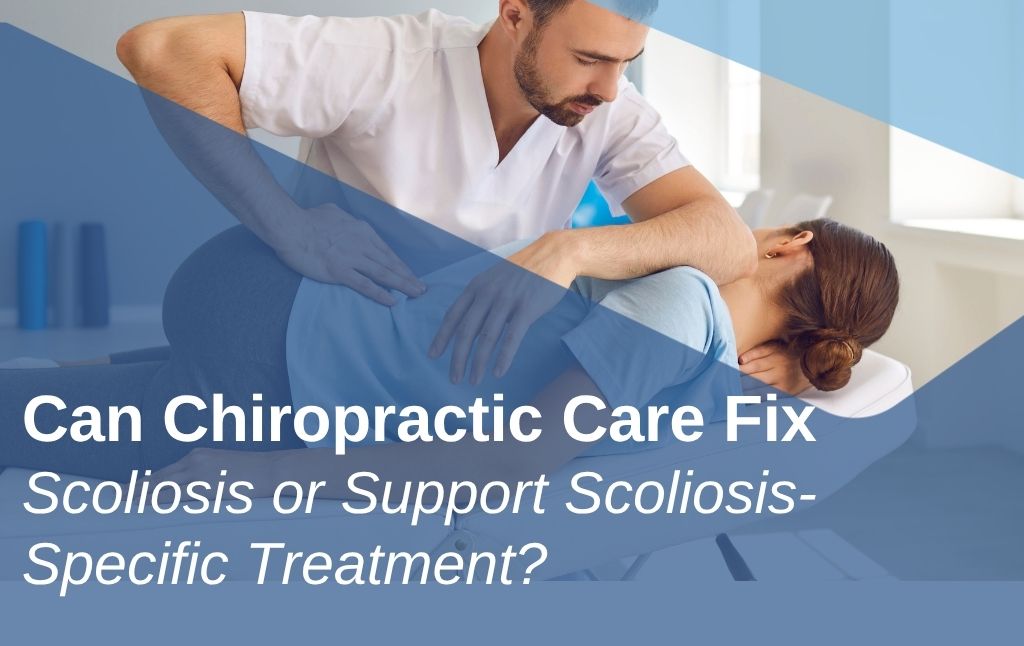
Scoliosis disrupts the spine’s balance and stability by causing an unnatural sideways curve with rotation. It can cause pain, poor posture, reduced mobility, issues with nerve communication, and more. If left untreated, the nature of scoliosis is to increase, but early diagnosis and a proactive treatment plan may minimize its impact.
When chiropractic care is scoliosis-specific, it can support correction and pain relief, and when combined with other effective treatment disciplines, it can be part of a broad treatment plan that supports the spine’s balance and alignment.
A comprehensive spine assessment is needed to understand a patient’s curve and make suitable treatment recommendations.
Chiropractic Care and Scoliosis
When chiropractic care is scoliosis-specific, it can be an effective nonsurgical treatment option that supports corrective results.
When a patient has an initial scoliosis assessment, a detailed evaluation of the spine, posture, mobility, and strength are performed for a complete picture of spinal health and function.
If signs of scoliosis are further detected, an X-ray can confirm the presence of the spine’s unnatural curve, rotation, and determine its severity, along with a number of other important variables for treatment planning.
Chiropractic care for scoliosis can include a variety of techniques including traction, manual adjustments, spinal remodeling, and Mirror Image exercise.
 Chiropractic BioPhysics® is a further specialization of scoliosis-specific chiropractic care that supports spinal flexibility for responsiveness, alignment for balance, pain relief, postural correction, and integration with additional scoliosis-specific treatment modalities.
Spinal Flexibility
Curve flexibility is an important variable for treatment planning. Curves that are more flexible usually have more corrective potential because their position can be more easily improved and supported, and an effect of scoliosis progressing is increasing spinal rigidity. Spines that are rigid may be less responsive to treatment.
Scoliosis-specific chiropractic care can include manual adjustments, traction, targeted exercise, and decompression that focuses on flexibility and mobility.
Increasing flexibility also supports pain relief caused by stiffness and a reduced range of motion.
Spinal Alignment
The underlying structural nature of scoliosis is the spine’s misalignment. A healthy balanced spine is straight from the front, neutral, and supports the straight and upright position of the torso for healthy posture and movement patterns.
The spine’s balance is key to its stability, and if the spine is unnaturally curved and twisted, its balance is disrupted because its vertebrae aren’t evenly stacked on top of one another. The more unnaturally tilted the spine’s vertebrae are, the larger the curve, and the more noticeable and painful its effects may be.
The spine also protects the spinal cord and the 31 pairs of spinal nerves that make up the central nervous system, so nerve health can also be affected by the spine’s unnatural position.
Improving the spine’s alignment can take pressure off compressed nerves for pain relief and improved nerve communication.
Symptom Relief
One of the main reasons people see chiropractors is symptom relief for a better quality of life. Most people will deal with back pain at some point in their lives, and for patients with severe scoliosis curves, it can be debilitating.
Increasing spinal flexibility through a variety of techniques, manual therapy, and scoliosis-specific exercise, relieves stiffness and pain and helps preserve healthy movement patterns and posture.
Improving the spine’s alignment and balance addresses some of the structural issues contributing to pain and compression, and uneven pressure on nerves can cause a number of unpleasant sensations from muscle weakness to shooting pain and numbness.
 Even incremental improvements to the spine’s balance can make a big impact on pain, especially for older adults with degenerative curves.
Scoliosis-specific chiropractic care can include Chiropractic BioPhysics®: a scientific approach to assessing and treating misalignments of the spine.
Chiropractic BioPhysics in Scoliosis Treatment
At the Scoliosis Center of Utah, patients benefit from the Chiropractic BioPhysics® advantage. Only 1 percent of the world’s chiropractors are certified and practice CBP. It’s a highly specialized evidence-based technique that focuses on postural correction.
Postural changes are a main effect of scoliosis, and CBP supports postural awareness and correction. Proper posture supports the spine’s healthy alignment and is key to leading a spine-friendly lifestyle and sustaining scoliosis treatment results long term.
A patient’s curve and posture is scientifically assessed to develop a suitable treatment plan. Treatment plans are based on functional deficits, changes to mobility, pain, and restoring alignment.
Chiropractic BioPhysics® treatment plans may combine a variety of techniques, routine adjustments, spinal remodeling, and Mirror Image® exercise.
Mirror Image® exercise supports postural awareness by teaching patients how to recognize unhealthy posture and movement and reposition their bodies appropriately. Mirror Image® exercise can also help retrain muscles for more spinal support. Patients who better understand their curves and the importance of proper posture have more power in the correction process.
Here at the Scoliosis Center of Utah, our CBP patients almost always experience improvement because the underlying cause of pain and functional issues is being assessed and addressed.
The Integration of CBP with ScoliBalance and ScoliBrace
Each scoliosis curve is unique, and treatment recommendations are personalized around the specifics of a patient’s curve, severity, posture, body type, and more. In some cases of small flexible cures that aren’t progressing quickly, scoliosis-specific exercise or bracing alone may support improvement, but in cases of larger progressive curves, a broader treatment plan may be recommended.
Nonsurgical scoliosis treatment recommendations may include CBP, ScoliBalance®, and ScoliBrace® working together towards the common goal of restoring the spine’s alignment.
ScoliBalance® is a customized scoliosis-specific rehabilitative exercise program that works with CBP to further support flexible curve reductions, pain relief, spinal alignment, muscle balance and strength, and more.
ScoliBalance® therapy involves the collaboration of chiropractors, therapists, and physical therapists in designing the most personalized and specific rehabilitative exercise plan for each patient’s treatment needs.
Scoliosis-specific exercise can target the core and back muscles to offer support and stability, and if CBP is working towards addressing the spine’s misalignment and rotation, further improvement may be supported if the spine is surrounded by strong and balanced muscles.
In cases of larger progressive curves, a board treatment plan combining scoliosis-specific chiropractic care, exercise plans, and corrective bracing may be recommended.
Bracing may also be recommended for short-term pain relief and increasing stability in older patients with degenerative curves.
Corrective bracing supports further postural correction by maintaining the spine and torso’s straight position, and as many braces are worn fulltime, the connection between the spine’s new position, its surrounding supportive muscles, and the brain is being strengthened.
When patients have fulfilled the brace-wearing recommendations and are no longer wearing the brace, the goal is that the spine and body’s position is maintained outside of the brace.
Scoliosis can be a complex condition to treat, especially when curves are severe and risk of progression is high, but when assessed early and treated proactively, scoliosis-specific chiropractic care can be combined with additional treatment modalities to impact scoliosis on every level.
Conclusion
Scoliosis-specific chiropractic care supports spinal flexibility for treatment responsiveness, a balanced alignment of the spine’s vertebrae, pain and symptom relief, and correction.
There is a significant difference between addressing the symptoms of scoliosis or the cause of the symptoms, and Chiropractic BioPhysics® assesses the spine and body to get to the root cause of back pain and misalignments.
Chiropractic BioPhysics® is a highly-specialized branch of chiropractic care. It involves a scientific analysis of a patient’s posture and curve for evidence-based treatment recommendations. CBP has postural correction at its foundation, and when combined with Mirror Image® exercise, targeted scoliosis-specific exercise, and corrective bracing, the potential for correction increases and addresses broad treatment needs.
When chiropractic care is scoliosis-specific and proactive, it can be an integral part of a patient’s treatment plan and path forward.
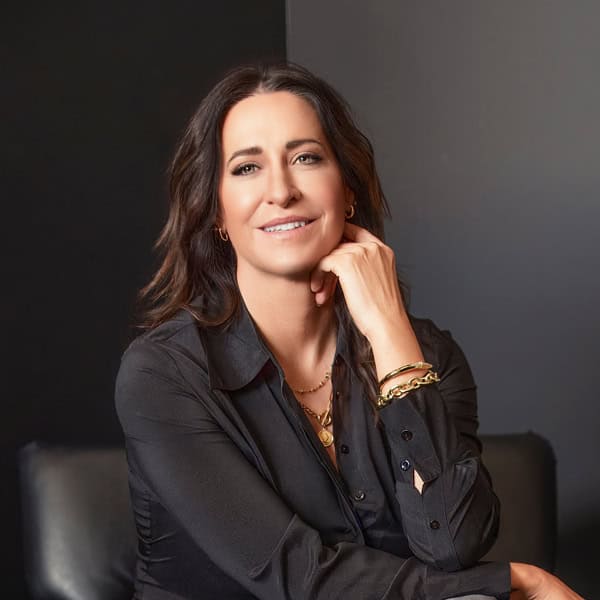
Dr. Katalina Dean
Dr. Katalina Dean is the founder and clinical director of Scoliosis Center of Utah, in Midvale, UT. Her team specializes in posture correction, spinal rehabilitation, and non-invasive scoliosis care and bracing.
Call Today
Do You Qualify for Care?
Schedule an Appointment Below