
Blogs
Best Type of Mattress for Scoliosis Support
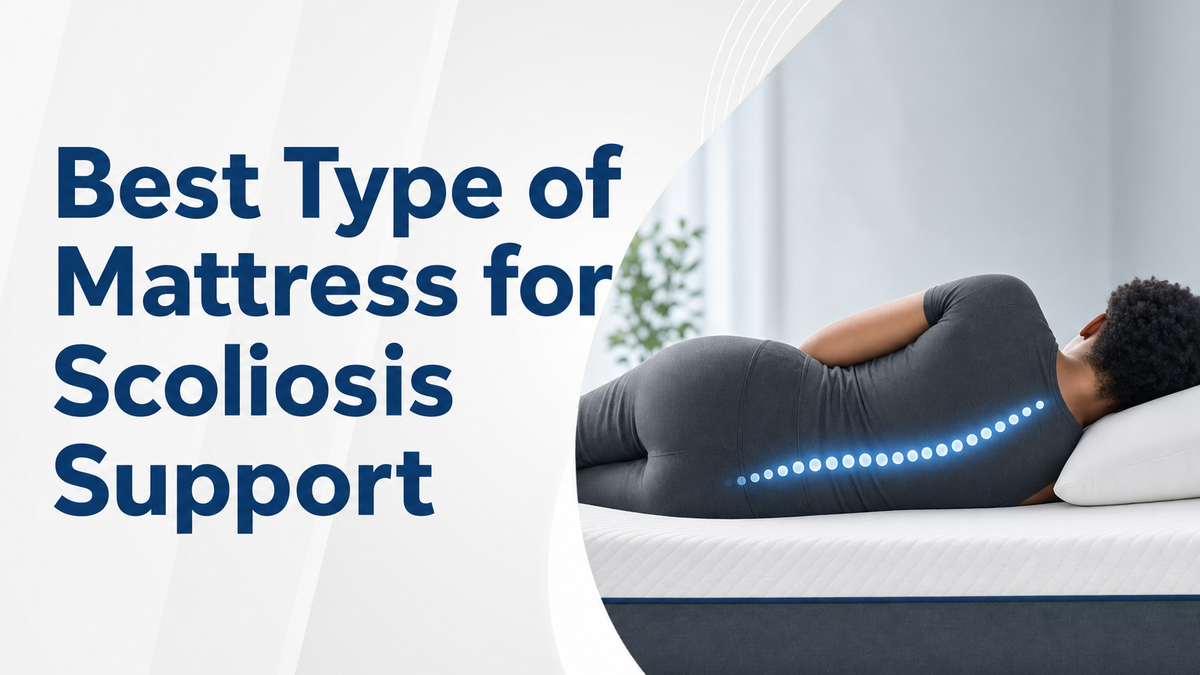
Scoliosis patients can experience a number of challenges, including discomfort and disruptions to sleep. From difficulties getting comfortable to pain, the more severe a patient’s scoliosis, the more likely it is to cause sleep problems, but when treated proactively, scoliosis can be highly treatable.
It’s estimated that approximately 65 percent of scoliosis patients experience sleep disruptions. The best type of mattress for scoliosis support is one that promotes spinal alignment while providing support and comfort. With a firm supportive mattress for scoliosis, patients are more likely to get a good night’s sleep and have the energy needed for healing and treatment.
Sleep quality is important for everyone, but for scoliosis patients, it can help with restoration, healing, and treatment efficacy.
The Best Mattress for Scoliosis
The best mattress for scoliosis is one that facilitates quality sleep, comfort, spinal support and alignment.
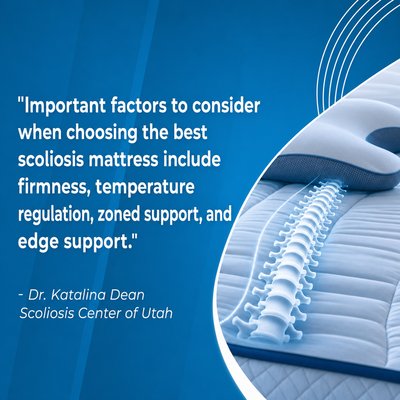 Important factors to consider when choosing the best scoliosis mattress include firmness, temperature regulation, zoned support, and edge support.
Firmness
When it comes to firmness, a medium-firm mattress is recommended. A mattress that’s too firm adds pressure to the spine, while a soft mattress allows the body to sink into the mattress, rather than supporting it.
Firmness preference is a personal choice, but for scoliosis patients, comfort and pressure relief are important, and a mattress that offers full support can minimize pressure points.
Temperature Regulation
Temperature regulation can help with sleep quality, and hybrid and latex mattresses offer temperature regulation by using breathable materials that disperse body heat evenly to achieve an ideal neutral-temperature sleep environment.
So hot sleepers can benefit from a cooling mattress that prevents heat retention for superior temperature control.
Support
When it comes to scoliosis and mattress choice, a key factor is the type of support, and zoned support uses zoned technology to provide targeted support under the hips/torso with less support under the shoulders; this helps maintain a neutral spinal alignment.
Strong edge support is beneficial because it supports a larger stable sleep surface that’s easier to get in and out of; this is ideal for scoliosis patients who get up frequently throughout the night.
Hybrid Mattress for Scoliosis
A medium-firm hybrid mattress is often recommended for scoliosis because it conforms to body shape for optimal support and pressure relief, with coil support to promote spinal alignment.
A hybrid mattress offers the best of both worlds: support and comfort.  Scoliosis is an asymmetrical condition that can disrupt the body’s overall symmetry, making it difficult to get balanced support and find a comfortable sleeping position.
The individually-wrapped coils are supportive and can adapt to asymmetrical body shapes and positions, and memory foam layers and latex top covers can be added for comfort and pressure relief.
Latex Mattress for Scoliosis
A latex mattress for scoliosis responds to position changes, offers firm support, and helps with temperature regulation.
Latex is a more responsive mattress than memory foam so is ideal for scoliosis patients that change positions frequently throughout the night; the mattress offers a natural responsive surface and level of support that makes it easier to maintain spinal alignment during and position changes throughout the night.
Memory Foam Mattress for Scoliosis
Memory foam mattresses for scoliosis are ideal for those experiencing pain and in need of pain relief throughout the night.
Because a memory foam mattress conforms closely to the body, it’s ideal for providing pressure and pain relief.
A memory foam mattress is ideal for those who don’t frequently change position during sleep and can benefit from optimal contoured support and pressure relief.
Ultimately, mattress preference is a personal choice, and what’s most important for a scoliosis patient is that they’re comfortable and can get a good night’s sleep because while not all scoliosis patients struggle with sleep, the spinal condition can disrupt sleep in a number of ways.
Scoliosis and Sleep
Studies have shown that approximately 65 percent of scoliosis patients will experience disruptions to sleep.
Scoliosis ranges widely in severity, and mild cases tend to cause mild symptoms, while moderate and severe scoliosis is more likely to cause overt effects and disrupt sleep.
Scoliosis can affect sleep quality due to pain, difficulty finding a comfortable sleep position, and breathing issues.
Scoliosis pain can involve the back, the nerves, and the spine’s supportive structures, and for adults, scoliosis is compressive so is more likely to cause back and nerve pain than childhood scoliosis.
Scoliosis strains the spine and the spine’s supportive muscles, and back and muscle pain can make it difficult to fall asleep and/or stay asleep.
Getting into a comfortable sleeping position can be challenging for some scoliosis patients; the spine’s asymmetrical curve and the condition’s asymmetrical effects can make lying flat on the back difficult, while lesser sleep positions can increase pressure.
For some patients with severe scoliosis, breathing problems can develop. While breathing issues aren’t considered a primary scoliosis symptom and are more associated with severe cases and/or untreated scoliosis, they can be disruptive.
Compression and a loss of space within the chest cavity can mean pressure on the lungs, and this can make it difficult to fully inhale, exhale, and settle into a rhythmic breathing pattern during sleep.
It can also be helpful for scoliosis patients to be aware of the best sleep position for scoliosis.
Sleeping Position and Scoliosis
The preferred sleeping position for spinal health is the same for people with and without scoliosis because it offers support, aligns the spine, and minimizes pressure points for extra pressure relief.
Sleeping flat on the back is the best sleep position for scoliosis because it helps evenly distribute weight, and the spine is held in a natural, aligned, and neutral position.
After back-sleeping, sleeping on the side is considered the next best sleep position, and when a thin pillow is placed between the knees, this improves the spine’s alignment and balance.
Stomach sleeping is putting pressure on the entire spine and as the neck has to turn to the side, the cervical spine is being held in an unnatural position.
Sleep styles vary from person to person, but awareness of the value of proper alignment and support can help ensure optimal spinal alignment and spinal health.
Conclusion
Mattress choice and sleep position can shape a person’s sleep quality, and scoliosis patients, whose spines are exposed to uneven forces, have a more pressing need for comfort and support from a supportive sleep surface.
The following mattresses are considered beneficial for scoliosis patients in terms of support, temperature regulation, comfort, and spinal alignment: the WinkBed, the Saatva, and the Nolah Natural.
Scoliosis patients may experience pain and disruptions to sleep, and while a high quality mattress can help minimize discomfort during sleep, the best approach to minimizing the potential effects and complications of scoliosis is committing to a proactive nonsurgical treatment plan.
Here at the Scoliosis Center of Utah, patients benefit from a comprehensive level of care that includes lifestyle guidance, and good sleep quality is important for meeting treatment needs.

Dr. Katalina Dean
Dr. Katalina Dean is the founder and clinical director of Scoliosis Center of Utah, in Midvale, UT. Her team specializes in posture correction, spinal rehabilitation, and non-invasive scoliosis care and bracing.
Call Today
Do You Qualify for Care?
Schedule an Appointment Below