
Blogs
Boston Brace, Tlso Brace, And Modern Custom Scoliosis Bracing
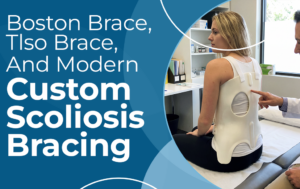
Scoliosis bracing is an evidence-based non-operative treatment that supports the spine and torso’s straight upright position and alignment. It’s important for patients and families to understand, however, that not all braces offer the same results, and there is a significant difference between a traditional TLSO brace and a modern corrective brace.
The boston brace is the most commonly prescribed TLSO scoliosis brace, but its potential efficacy is limited because it doesn’t address the spine’s rotation and its squeezing design can weaken the spine. The modern corrective ScoliBrace® supports 3-dimensional correction, and because it’s designed to work with movement, its potential efficacy increases when combined with a personalized scoliosis-specific exercise plan.
Scoliosis is a 3-dimensional spinal condition that requires a 3-dimensional solution.
Scoliosis Bracing
Here at the Scoliosis Center of Utah, bracing may play a key role in addressing scoliosis in children, adolescents, and adults. Scoliosis causes the spine to curve unnaturally to the side and rotate and can have widespread effects including the development of uneven posture, muscle, and back pain.
Scoliosis curves can also increase and are more likely to progress when growth or declining spinal health is happening, so children and older adults are the most prone to quick curve progression, but each case is unique, and care plans are based on the results of a thorough and personalized spine assessment.
Scoliosis bracing is evidence-based and when combined with other curve-management strategies, the spine’s healthier position and body posture may be improved and supported.
Scoliosis bracing has changed a lot over the years. This is clear when considering some key differences between the traditional boston brace and the modern ScoliBrace®.
Traditional Scoliosis Bracing
A TLSO brace is a thoracolumbosacral orthosis that is a type of rigid orthosis worn around the torso, and the boston brace, the wilmington, and the charleston bending brace are common examples.
Traditional scoliosis bracing is more prefabricated than modern options, and the biggest challenge to bracing treatment success is compliance.
For a brace to function as it’s supposed to, it has to hold the spine and torso in a straighter position for a certain amount of hours a day, and for children, this may be until growth stops. Full-time wear is common when treating adolescent idiopathic scoliosis and may mean up to 23 hours a day and include wearing the brace to school and during sleep.
As you can guess, not all teens comply with the strict brace-wearing regimen that its potential is based on.
Traditional braces like the boston had limited success but didn’t always produce good compliance, in part, due to its pre-fabricated design, and also due to its squeezing design. The boston uses a 3-point pressure system to influence the spine’s position, but the intense squeezing is uncomfortable, can cause breathing difficulties, weaken the spine over time, and isn’t easy to move in.
If a TLSO brace is removed and shoved in a school locker during peak daytime growth hours, its efficacy isn’t supported, and this is a major barrier to positive treatment outcomes.
Modern correcting bracing, however, recognized some drawbacks associated with traditional braces and adjusted accordingly with the industry-leading ScoliBrace®.
The Modern Corrective ScoliBrace®
The modern corrective ScoliBrace® recognized the challenge of compliance and considered it from the start with advanced 3D scanning software and digital X-rays that customize each brace to a patient’s body and curve type for a truly custom fit.
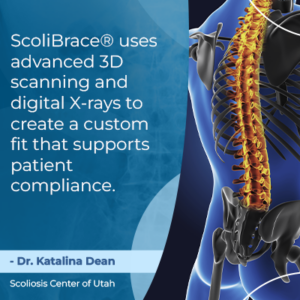
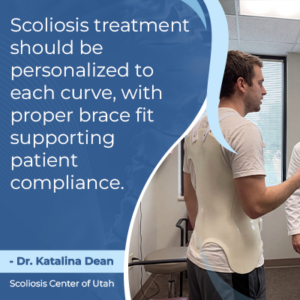
Tailored clinical management is recommended for scoliosis because curves vary widely in severity and effects, and starting with a good fit supports compliance.
In addition, the ScoliBrace® is designed to be easily done up and undone at the front so patients need minimal assistance.
A dedicated team of designers collaborates on each patient’s brace for the ideal design, fit, and makes adjustments as needed.
While traditional bracing uses 3-point pressure, the ScoliBrace® has a different approach. It uses spinal coupling to place the spine in a position opposite to its unnatural curve and rotation, and because it doesn’t apply as much squeezing pressure to the spine, and because it’s designed to be used with movement, the spine’s surrounding muscle strength is also supported.
For infants and juveniles, the ScoliBrace® may reduce curve size, manage progression, and improve body appearance and self esteem.
For adolescents, the ScoliBrace® may reduce curves, rib humping, and postural imbalance such as uneven shoulders and hips while supporting postural awareness and restoration.
Once growth stops, curves tend to stabilize or slow their progression, but this also means the curve is now rigid and has less corrective potential, so in-brace correction is supported by growth, and bracing for adults is more about symptom relief than correction.
In adults, modern bracing may slow progression, provide short-term pain relief, improve body posture, and balance, and when it comes to adult scoliosis pain, the good news is that it’s not as related to the size of the curve as much as the spine’s balance, so even incremental improvement to an adult’s sagittal balance can improve back and nerve pain for a better quality of life.
ScoliNight®
There is also the modern corrective ScoliNight® that’s designed to work while a patient sleeps, is only worn at night, and is ideal for young patients with small curves when used as early intervention.
Because nighttime bracing doesn’t have to account for movement while wearing the brace, it can hold the spine in a hyper-corrective position to counteract the curve and manage progression before significant growth, rather than during growth spurts.
The goal of nighttime-only bracing is to stop curve progression before growth spurts trigger significant progression, to avoid the need for full-time bracing, and/or surgical intervention.
ScoliBalance®
One of the most significant advantages of modern bracing is its integrative design. For appropriate cases, the ScoliBrace® can be combined with a personalized scoliosis-specific exercise program.
Scoliosis is a complex condition, and in most cases, it takes more than one type of treatment to impact the spine’s unnatural curve, rotation, and related muscle and postural changes.
ScoliBalance® therapy involves a dedicated team of therapists, physical therapists, and chiropractors collaborating to design a patient-centered care plan that doesn’t just address the spine, but the potential whole-body effects of scoliosis, with a focus on postural correction.
ScoliBalance® personalizes scoliosis-specific exercise recommendations around the specifics of a patient’s curve, body type, and posture, and uses Mirror Image® exercise to educate patients on how they are holding their body, how body posture affects the position of the spine, and how scoliosis corrections can be sustained and supported during daily activity through proper posture.
As part of a complete approach to scoliosis care that combines bracing with rehabilitative scoliosis-specific exercise for appropriate patients, ScoliBalance® may slow or stop progression, help reduce flexible curves, improve balance and stability, provide pain relief, improve the spine and body’s flexibility, body posture, appearance, and supports fall prevention in older adults.
Studies support that the ScoliBrace® becomes more effective when paired with a customized scoliosis-specific exercise program like ScoliBalance® (1).
Conclusion
Bracing often plays a key role in the nonoperative management of childhood scoliosis, and parents of children recently diagnosed should clearly understand their child’s curve and all treatment options available to them.
Growth is a challenge of addressing childhood curves because it triggers progression, but it also affords an advantage. Growing spines are more flexible, and in-brace correction is only possible for young patients who have not yet reached skeletal maturity.
So while bracing may be used for adults to manage pain and progression, in-brace correction is part of childhood scoliosis treatment.
While a traditional scoliosis braces such as the boston brace is limited due to compliance issues, its 2-dimensional design, and its immobilizing effect, the modern corrective ScoliBrace® features a custom 3D design, corrective potential, and can be combined with ScoliBalance® to further impact the spine and its surroundings muscle health and balance.
References:
- Marchese R, Du Plessis J, Pooke T, McAviney J. The Improvement of Trunk Muscle Endurance in Adolescents with Idiopathic Scoliosis Treated with ScoliBrace® and the ScoliBalance® Exercise Approach. J Clin Med. 2024 Jan 23;13(3):653. doi: 10.3390/jcm13030653. PMID: 38337346; PMCID: PMC10856658
Dr. Katalina Dean
Dr. Katalina Dean is the founder and clinical director of Scoliosis Center of Utah, in Midvale, UT. Her team specializes in posture correction, spinal rehabilitation, and non-invasive scoliosis care and bracing.
Call Today
Do You Qualify for Care?
Schedule an Appointment Below