
Blogs
Scoliosis X-rays, Cobb Angle, and What Curve Measurements Mean
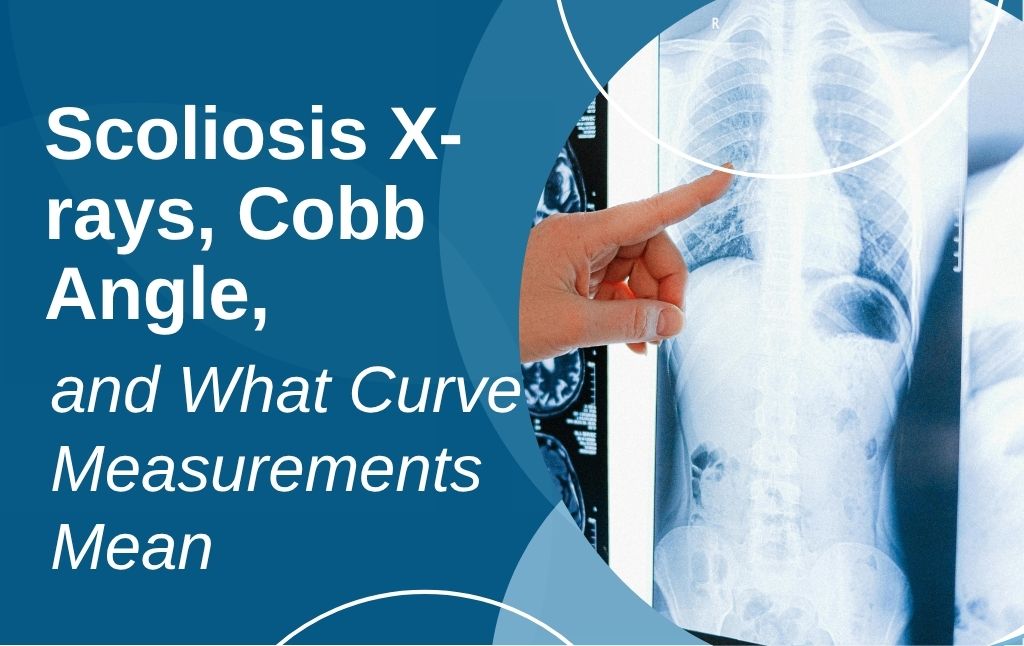
An X-ray is needed to confirm the spine’s unnatural lateral curve, determine the size of the curve, and that the spine also twists (rotational component). Once we know what’s happening in and around the spine, we can make suitable scoliosis treatment recommendations.
A scoliosis X-ray is needed to diagnose scoliosis and involves a number of key measurements for treatment planning. A patient’s Cobb angle determines curve severity, and its accurate and precise measurement is crucial because it’s compared to during care to assess how the curve is responding to growth, any other changes, and treatment.
If you’ve noticed signs of scoliosis in yourself, or a child, a timely assessment supports early detection for early intervention.
Diagnosing Scoliosis
Diagnosing scoliosis isn’t always easy. Sometimes, its effects can be subtle and difficult to notice, but having awareness of the early signs to look for can alert parents to the need for assessment.
In children, the earliest signs of scoliosis are postural changes such as uneven shoulders and uneven hips. An arch in the rib cage is also common because of the thoracic spine’s attachment to the rib cage.
In adults, pain and postural decline are common signs that scoliosis has developed and/or is progressing.
After a patient’s initial assessment, if risk factors are identified, and/or there are visual signs of scoliosis, an X-ray is the next step and is needed to diagnose scoliosis.
What a Scoliosis X-Ray Tells Us
A scoliosis X-ray confirms the presence of an unnatural lateral spinal curvature, the direction of the curve, the main spinal section affected, and the curve’s rotation.
No two cases of scoliosis are the same, so treatment plans need to be customized around key patient and condition variables, most of which are determined during a patient’s scoliosis X-ray.
Usually, the first measurement taken is a patient’s Cobb angle because the size of the curvature has to be at least 10 degrees to be considered a true scoliosis.
Cobb Angle and Curve Severity
 Cobb angle is a key measurement for treatment planning because it tells us the size of the spine’s unnatural curve and whether it’s considered mild, moderate, or severe, and a goal of treatment, in many cases, is to reduce a patient’s curve size, so the measurement is referred back to throughout the course of treatment to see how the spine is responding.
The measurement also indicates how the spine is responding to other factors such as growth or age-related degenerative changes, so a patient’s Cobb angle needs to be measured with accuracy and precision because it will direct treatment planning and adjustments.
The higher a patient’s Cobb angle, the more severe the curve, and the more noticeable its effects are likely to be, along with continued progression. There are a number of factors that contribute to a patient’s risk of curve progression, but curve severity is key. Large curves introduce more imbalance to the spine, and larger imbalances are likely to continue increasing, particularly when progressive triggers such as growth or declining spinal health are occurring.
Changes to a patient’s Cobb angle indicates the curve is changing so the spine needs to be assessed and treatment adjusted as needed.
Angle of Trunk Rotation
Because scoliosis doesn’t just cause the spine to curve unnaturally to the side, but also twist, it’s a 3-dimensional condition with unique treatment needs. A scoliosis X-ray involves determining a patient’s angle of trunk rotation (ATR).
Curve location is also important because the spine’s main sections work together to maintain overall balance and stability, and because of the unique roles of each section, certain curve locations are associated with specific symptoms and/or progressive rates.
 Thoracic scoliosis, for example, that develops in the middle/upper back is associated with more rotation so progression risk increases, and any variable that’s affecting a patient’s curve needs to be assessed and factored into treatment planning.
So a patient’s angle of trunk rotation tells us how much twist there is in the spine and helps us determine progression risk.
Curve Direction
A patient’s X-ray also tells us if the curve is typical and bends towards the right to protect the heart, or is a left curve that’s considered atypical and warrants closer assessment to rule out an underlying cause.
The vast majority of idiopathic curves are right-bending, known as dextroscoliosis, and left curves are less common and known as levoscoliosis.
Not all left curves are problematic, and curve location matters again. Left curves that develop in the lumbar spine may not pose any extra treatment challenges, but left curves that develop in the upper thoracic spine may be problematic due to its close proximity to the heart and lungs.
In severe upper thoracic curves, lung and heart function may be affected, and in some cases, these curves are driven by an underlying neuromuscular condition such as cerebral palsy, muscular dystrophy, or spina bifida. In these cases, the scoliosis has developed as a secondary complication so curves tend to be rigid and severe and can progress quickly.
So we know a scoliosis X-ray is needed to confirm the presence of the spine’s unnatural sideways curve, rotation, curve size, direction, location, and angle of trunk rotation, but what else do X-rays tell us?
As mentioned, there are a number of factors that can feed a curve, and they all have to be assessed, understood, and factored into treatment planning, and when patients are at an increased progression risk, an X-ray may have to focus on additional variables such as a young patient’s growth stage or spinal stability in older adults.
Growth Stage
The most common type of scoliosis is adolescent idiopathic scoliosis diagnosed during adolescence, but scoliosis affects patients of all ages.
Because growth is the main progressive trigger in children, assessing a patient’s rate of growth and how much remaining growth they have can shape a treatment plan, so a child’s scoliosis X-ray may also assess bone age to determine a patient’s progression risk.
A patient’s Risser sign indicates their level of skeletal maturity by assessing growth plates on the pelvis and top of the hip bone. Combined with a young patient’s Cobb angle measurement, the Risser sign helps us predict, with the most accuracy, a patient’s rate of growth and progression because two patients of the same age can enter into puberty at the same time but still grow at different rates.
The more detailed information we have about a patient’s curve and progression risk, the more specific a treatment plan can be.
Assessing Instability
Older adults are also more vulnerable to progression due to declining spinal and/or bone health. Age-related changes can be the result of lifestyle factors that, over time, have affected the spine’s health and function such as carrying excess weight, too little movement, chronic poor posture, and more.
Many older patients are experiencing postural decline, which is common as we age, and this can be the result of weakening muscles and/or the downward pull of gravity that’s harder to resist with increasing age.
If the spine’s discs and facet joints are experiencing degenerative changes, the spine’s stability can be disrupted and further contribute to the onset of degenerative scoliosis.
Most common in adults over 50, degenerative curves can be fed by weak muscles, poor posture, degenerative changes in the spine, and changes to bone strength. Conditions such as osteopenia, osteoporosis, and low bone density related to menopause may also compound curve progression.
So scoliosis X-rays on older adults look closely at the spine’s stability. The spine was designed for movement, but too much movement within the spine means instability, and instability in the spine usually means unstable movement and a loss of balance.
An older adult’s stability needs to be assessed for fall-prevention strategies because most degenerative curves are progressive, so a scoliosis X-ray can also indicate a patient’s level of spinal stability.
Conclusion
When a patient’s initial scoliosis X-ray is thorough and considers all factors that may be contributing to the onset or progression of scoliosis, a detailed treatment plan can be drafted.
Following the results of a patent’s X-ray, details about the curve and progression risk are discussed. Patients with a better understanding of their curve, and factors that may contribute to its progression, can be more involved in the process and make informed lifestyle and treatment choices.
In many cases, a timely assessment and scoliosis X-ray supports early detection, intervention, and better patient outcomes.

Dr. Katalina Dean
Dr. Katalina Dean is the founder and clinical director of Scoliosis Center of Utah, in Midvale, UT. Her team specializes in posture correction, spinal rehabilitation, and non-invasive scoliosis care and bracing.
Call Today
Do You Qualify for Care?
Schedule an Appointment Below