
Blogs
Scheuermann’s Kyphosis: Causes and Symptoms
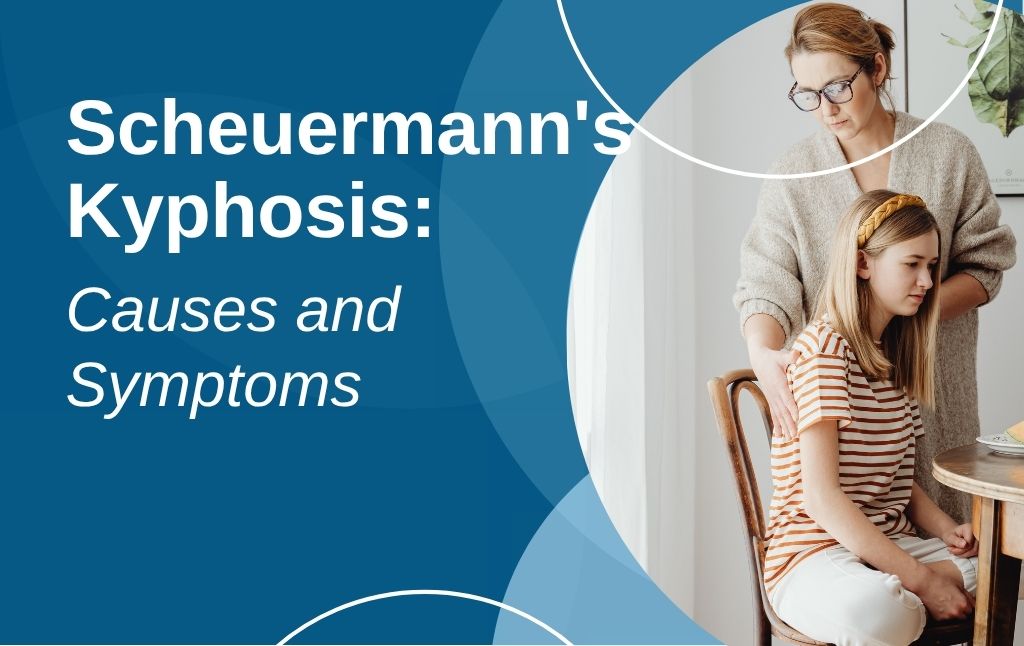
Overall spinal health is shaped by a number of factors, including the sizes of the spine’s curve in each of the main spinal sections. Kyphosis refers to the spine’s outward curve found in the thoracic spine, and too much kyphosis causes the middle/upper back to round forward excessively.
Too much kyphosis can have different causes, and Scheuermann’s kyphosis is linked with uneven vertebral growth during adolescence. If 3 or more vertebral bodies are growing slower at the front than the back, they can form a wedge shape, and vertebral wedging can cause an excessively forward-rounded spinal curve. Symptoms can include poor posture, muscle fatigue, difficulty breathing and back pain.
Scheuermann’s curves are structural, rigid, and need to be thoroughly assessed to direct treatment.
What is Scheuermann’s Kyphosis?
Kyphosis describes the spine’s outward curve found in the thoracic spine (middle/upper back), and lordosis is found in the cervical (neck) and lumbar (lower back) spinal sections. Together, the spine’s kyphosis and lordosis balance each other out for strength, flexibility, and shock absorption.
But what happens if the thoracic spine, the largest spinal section, develops too much kyphosis? The thoracic spine contains 12 vertebrae, is the only section that attaches to the rib cage, and forms the thoracic cage that protects the heart and lungs.
If the thoracic spine develops too much kyphosis, it curves outward excessively, causing the upper back and shoulders to round forward excessively.
There are a number of variables that shape whether a person’s kyphosis is considered problematic, one of which is patient age, but generally, a healthy range of kyphosis is considered to fall within 20 to 45 degrees, and a kyphosis degree of 50+ is often diagnosed as thoracic hyperkyphosis (excessive kyphosis).
Scheuermann’s Kyphosis Causes
While the exact cause of Scheuermann’s kyphosis isn’t fully understood, it mainly occurs during adolescence (10 to 15 years old), is more common in males, and is linked with uneven vertebral growth.
Because it involves structural abnormalities within the spine, it’s a structural spinal condition, and Scheuermann’s curves are rigid and likely to increase with rapid growth spurts.
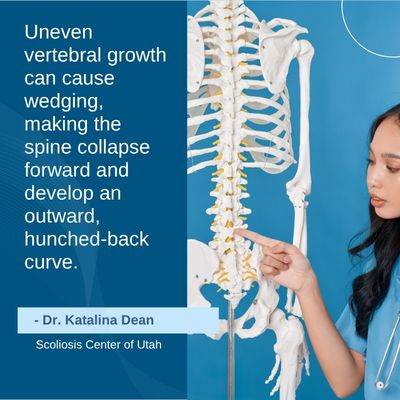 A healthy aligned spine has its vertebral bodies stacked on top of one another in a straight and neutral alignment, and this is facilitated by healthy rectangular-shaped vertebrae, but if vertebrae are growing unevenly during a growth spurt, and the front side is growing faster than the back, vertebral wedging may occur that causes the spine to arch outward excessively.
Scheuermann’s kyphosis involves 3 or more vertebrae forming into a wedge shape.
In addition to uneven vertebral growth, there are also genetic and mechanical factors that may contribute to increasing kyphosis. An inherited gene pattern accounts for why the condition seems to reappear in families and repeated mechanical stress (improper heavy lifting) during growth may also trigger its onset/progression. And theories involving weak cartilage and lack of blood flow around bone are also supported.
Kyphosis is likely to continue increasing during growth so, in many cases, proactive management is recommended.
Scheuermann’s Kyphosis Symptoms
Scheuermann’s kyphosis symptoms include a rigid rounded upper back and shoulders that don’t straighten with changes to position or active efforts to stand up straight.
Postural spinal conditions respond to changes in position because the curve is largely driven by the body’s unnatural position, but when curves are structural, they are caused by structural abnormalities within the spine itself, and will need to be impacted on more levels than just posture.
Pain is also a common sign of Scheuermann’s kyphosis. Middle and upper back stiffness may become chronic if left unaddressed and can worsen with activity and/or long periods of sitting or standing.
Muscle discomfort may also develop due to tight shoulders and hamstrings, and reduced mobility is a common effect of structural spinal changes and postural changes.
Managing Kyphosis
Treatment recommendations for managing kyphosis will be patient-specific.
Small curves that aren’t causing pain and disruptive symptoms, and aren’t increasing with growth, may be recommended for monitoring.
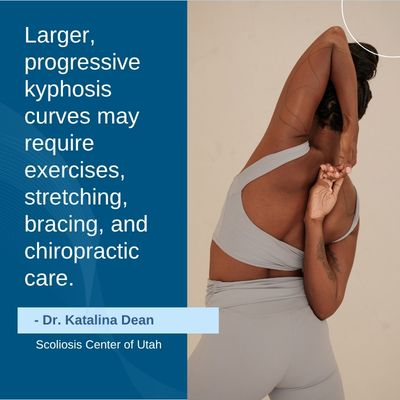 Larger curves that are increasing and causing pain and mobility challenges may require a comprehensive treatment plan combining kyphosis-specific core and back strengthening exercises and stretches with bracing and chiropractic care.
Kyphosis Exercise
Here at the Scoliosis Center of Utah, a specialized rehabilitative exercise-based approach (ScoliBalance®) is used to treat scoliosis and kyphosis in children and adults.
It involves a comprehensive assessment of a patient’s curve and postural issues, and determining whether targeted exercise, bracing, and/or chiropractic care can improve the spine’s position, support, stability, and body posture.
Rehabilitative kyphosis exercise may help with symptom relief and curve correction by increasing the spine’s flexibility for pain relief, responsiveness to treatment, and improved mobility, and teaching mindful movement and intentional breathing can further build on postural improvements supported by a stronger core and back.
During periods of rapid growth, because growth can trigger progression, bracing may be recommended to prevent the curve from worsening. Once growth stops and skeletal maturity is reached, the spine’s position is more fixed and harder to improve.
If the spine develops an unhealthy curve, many areas of spinal health can be affected. The spine’s structure, muscular support, nerve health, and disc health can be disrupted. If the spine curves unnaturally, the uneven forces can affect the muscles that support the spine, the discs that sit between adjacent vertebral bodies, and the facet joints that connect vertebrae, and uneven wear may occur over time.
Discs that are exposed to uneven pressure, loading, and wear, are more likely to degenerate faster. They are more vulnerable to degeneration, desiccation, and herniation.
Kyphosis exercises are customized and targeted. They support symptom relief, a stronger core, spinal flexibility, and postural retraining.
Kyphosis Bracing
When combined with modern corrective bracing that’s designed with movement in mind, in many cases, evidence supports that exercise and bracing complement one another.
The corrective KyphoBrace® is a type of ScoliBrace® designed to address a kyphotic deformity by restoring a healthy kyphotic angle for the patient’s age.
The KyphoBrace helps hold the spine and body in a straighter alignment for improvement to the spine’s position and overall body appearance and posture. Patients who wear their brace as prescribed are also strengthening the connection between the brain, the muscles, and supportive ligaments that surround the spine, and the body’s healthier aligned position; the goal is that the connection is maintained when not wearing the brace.
Bracing can support curve reductions and postural improvement.
Kyphosis-Specific Chiropractic Care
Here at the Center, chiropractors use Mirror Image exercise and a number of chiropractic techniques for a scientific approach to diagnosing and correcting vertebral subluxations (misaligned vertebral bodies).
Chiropractic BioPhysics® is an additional nonoperative management option that supports pain relief, relieves muscle tension, joint stiffness, and may improve spinal mobility and posture.
For severe curves causing chronic pain and neurological symptoms, surgical management (spinal fusion) may be recommended.
Scheuermann’s kyphosis patients benefit from a full correction system when kyphosis exercise and bracing is combined with chiropractic care and customized around the specifics of a curve.
In some severe cases involving chronic pain, fast progression, and neurological symptoms that don’t respond to non operative management, surgical treatment may be recommended.
Conclusion
Scheuermann’s kyphosis causes a person’s thoracic kyphosis (outward spinal curve) to become excessive. This most often occurs during the growth spurts of adolescence and can increase with growth.
The exact etiology of Scheuermann disease isn’t fully understood, but uneven growth of vertebral bodies and anterior wedging are considered a main cause. Normal thoracic kyphosis helps maintain the spine’s balance, and stability, and too much kyphosis can cause pain, mobility challenges, poor posture, and instability.
Early diagnosis and proactive conservative treatment focuses on managing progression during growth, works towards strengthening/balancing the spine’s surrounding muscles for more support and stability, and increasing the spine’s flexibility for pain relief, mobility, and treatment responsiveness.
If someone you care about is showing signs of Scheuermann’s kyphosis, a timely assessment can help direct patients on the best treatment options to address their specific postural issues and curve severity.
Dr. Katalina Dean
Dr. Katalina Dean is the founder and clinical director of Scoliosis Center of Utah, in Midvale, UT. Her team specializes in posture correction, spinal rehabilitation, and non-invasive scoliosis care and bracing.
Call Today
Do You Qualify for Care?
Schedule an Appointment Below