
Blogs
What Is Hyperkyphosis? Causes, Symptoms, Management

Spinal curve size can vary from person to person, but if a curve becomes exaggerated and falls beyond a normal range, it can be deemed unhealthy and problematic. The spine plays a number of key roles in maintaining overall health, including supporting healthy posture, movement patterns, and nerve health.
The spine’s natural curves keep it strong, flexible, and better able to handle mechanical stress. A diagnosis of hyperkyphosis means an exaggerated forward curvature of the spine has developed in the thoracic region.
The spine has three main sections, and each section has a characteristic curve type that facilitates its strength and function.
Healthy Spinal Curvatures
Spinal health is key to a person’s overall health.
A healthy spine facilitates healthy posture, and healthy posture promotes spinal health.
The spine’s balance and alignment shapes the body’s overall stability, and the spine’s main sections consist of the cervical spine (neck), thoracic spine (middle/upper back), and the lumbar spine (lower back).
The spine is naturally curved to make it stronger, more flexible, and better able to absorb and distribute stress.
Healthy spinal curves are key to the spine’s overall health and function, and unhealthy spinal curves can be under- or over-pronounced, and in cases of hyperkyphosis, there is an exaggerated kyphotic curve in the thoracic spine.
Thoracic Kyphosis
The thoracic spine is the largest spinal section consisting of 12 thoracic vertebrae, and as the only spinal section attached to the rib cage, it helps anchor the thoracic cage and protects important organs within (lungs, heart, and digestive organs).
In addition, the thoracic spine protects the spinal nerves within and facilitates a number of upper-body movements.
Thoracic kyphosis refers to the middle/upper back’s forward spinal curvature; a kyphotic curve bends forward in a reverse ‘C’ shape.
A healthy range of thoracic kyphosis is between 20 and 45 degrees, with hyperkyphosis diagnosed at 50+ degrees.
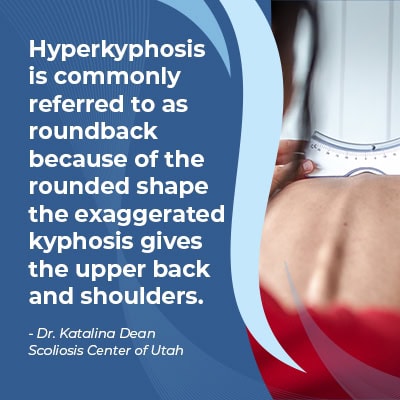 Hyperkyphosis is commonly referred to as roundback because of the rounded shape the exaggerated kyphosis gives the upper back and shoulders.
If a person’s thoracic kyphosis is excessive, it can disrupt posture and the spine’s biomechanics, and symptoms of hyperkyphosis are shaped by a number of variables such as the type of kyphosis, determined by causation.
Hyperkyphosis Causes
Excessive kyphosis can have a number of causes that will differ based on the type in question.
The most common type of kyphosis is postural hyperkyphosis diagnosed most often in adolescents; this type is caused by chronic poor posture that, over time, can weaken the ligaments and/or muscles that support the spine’s healthy alignment.
Because postural hyperkyphosis isn’t structural, the spine’s hyperkyphotic curve can be reduced with a change in position and/or posture. An active effort to stand up straighter and/or flatten the shoulders against a wall can straighten the curvature of the spine and improve its alignment.
As postural hyperkyphosis curves are non-structural, they are more flexible and the simplest to treat.
Conversely, Scheuermann’s kyphosis is a structural condition, meaning the cause involves structural abnormalities within the spine itself. Abnormal vertebral growth during adolescence is the cause of Scheuermann’s kyphosis.
The curves of Scheuermann’s kyphosis are rigid and involve one or more vertebral bodies having a wedge shape, rather than a healthy rectangular shape that facilitates the spine’s straight and neutral alignment.
Triggers for the initial onset of Scheuermann’s kyphosis aren’t fully understood, but theories include genetics, issues with bone and/or muscle health, and osteoporosis.
Scheuermann’s kyphosis is most often diagnosed during adolescence during periods of rapid growth, but it’s also common in aging adults.
Age-related hyperkyphosis is most common in females experiencing hormone and bone density changes related to menopause, and as degenerative instability increases over time, back pain and progression are common.
Symptoms of Hyperkyphosis
Symptoms of hyperkyphosis are shaped by patient age, cause, and severity, but common symptoms include postural changes that involve a slouching appearance with excessively-rounded shoulders and upper back.
Upper back and shoulder pain is common, as well as tight hamstrings and the development of forward head posture.
Back pain is common due to strained and sore muscles trying to counteract the spine’s unnatural pull, and tight hamstrings can develop as the muscles in the back of the thighs attempt to counteract the uneven distribution of the upper body’s weight over the pelvis.
Fatigue is common as the efforts needed to maintain an economical posture and gait increase over time.
Forward head posture develops as the upper back’s excessive kyphosis pushes the head forward, increasing its weight on the cervical spine.
Mild cases will produce more-subtle symptoms, and more severe cases can include nerve involvement, shortness of breath, and noticeable disruptions to balance.
In severe cases where there is a noticeable loss of space within the thoracic cage due to the spine’s excessive kyphosis, lung capacity can be affected, and when nerves are compressed, nerve function and health can also be disrupted.
Hyperkyphosis Treatment Options
Treatment plans for hyperkyphosis need to be customized around key variables such as patient age, cause, severity, and experienced symptoms.
For postural kyphosis, treatment plans generally consist of physical therapy and lifestyle guidance, but in cases that are structural, such as in Scheuermann’s kyphosis, treatment is more complex and has to impact the curve on a structural level.
When treating age-related hyperkyphosis, fall prevention is a goal and is worked towards through increasing the spine and body’s balance and stability.
Kyphosis-specific rehabilitative exercise programs, the application of Chiropractic BioPhysics, and the corrective KyphoBrace complement one another and have the potential to improve the spine’s alignment, balance, and stability.
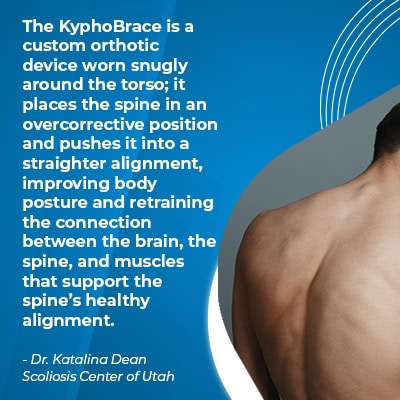 The KyphoBrace is a custom orthotic device worn snugly around the torso; it places the spine in an overcorrective position and pushes it into a straighter alignment, improving body posture and retraining the connection between the brain, the spine, and muscles that support the spine’s healthy alignment.
And through kyphosis-specific exercise-based treatment, any muscle weakness and or muscular imbalance can be addressed for improved spinal support and stability.
Here at the Scoliosis Center of Utah, hyperkyphosis treatment plans are proactive and customized with the goal of restoring the spine’s alignment, balance, and stability.
Conclusion
The spine’s overall health, function, and biomechanics are shaped by its natural and healthy curves, and if a curve becomes under- or over-pronounced, it can disrupt the balance and stability of the entire spine.
And if the spine is misaligned, the effects can be felt throughout the body from the head to the feet as spinal health and posture are linked.
A diagnosis of kyperkyphosis means the thoracic spine has developed an excessive forward-rounding spinal curve that is problematic.
Types of hyperkyphosis include postural, Scheuermann’s kyphosis, and age-related hyperkyphosis, and common symptoms include a roundback appearance, upper back and shoulder pain, nerve pain, and disruptions to balance and mobility.
The longer an unnatural spinal curve is left untreated, the more likely it is to cause related complications, disrupt healthy posture, and increase uneven wear on the spine that, over time, can put older patients at risk of injury through a fall.
The goal of hyperkyphosis treatment is to restore the spine’s balance and stability as this will improve the body’s overall balance, stability, and strength.

Dr. Katalina Dean
Dr. Katalina Dean is the founder and clinical director of Scoliosis Center of Utah, in Midvale, UT. Her team specializes in posture correction, spinal rehabilitation, and non-invasive scoliosis care and bracing.
Call Today
Do You Qualify for Care?
Schedule an Appointment Below