
Blogs
Dextroscoliosis And Thoracic/Lumbar Curve Direction

Most scoliosis curves bend to the right and are known as dextroscoliosis. When a left scoliosis develops, there may be an underlying pathology to consider because it’s an atypical curve pattern known as levoscoliosis.
Dextroscoliosis describes an unnatural sideways spinal curvature to the right that rotates. Thoracic dextroscoliosis develops in the middle/upper back and is the most common spinal section affected, and lumbar scoliosis curves develop in the lower back. Curve location and direction matter for treatment planning.
There are a number of curve details that are assessed before giving treatment recommendations, including whether a curve is to the right or left.
Dextroscoliosis and Curve Direction
Dextroscoliosis curves to the right and is the typical scoliosis curve direction. When curves bend to the left and are severe, they can affect the heart by compressing the chest cavity, and while severe right curves may affect lung function, cardiac effects are more closely associated with atypical left curves.
Along with left or right curve directions, there are also different types of scoliosis, and the most prevalent is idiopathic scoliosis that has no single-known cause. Right curves are the standard for idiopathic scoliosis, so if a left curve develops, it can be idiopathic, or have an underlying cause, and this signals the need for further testing.
An MRI may be necessary to check for neurological issues like the presence of an underlying neuromuscular condition that causes neuromuscular scoliosis or congenital abnormalities in the spine that affect how the spine forms.
Curve direction helps determine how much testing a patient needs, and typical cases of idiopathic dextroscoliosis are diagnosed through a physical examination and the results of a scoliosis X-ray.
Curve direction informs treatment planning, along with a number of other curve details such as location.
Curve Location: Why it Matters
When patients are diagnosed with scoliosis, there may be a lot of information to discuss including curve characteristics that shape a patient’s progression risk and treatment recommendations.
Curves that progress need treatment, but progression can be slow or fast, and depending on the patient and their curve, the timing of treatment can matter. Some curve types are more likely to change quickly so can benefit from proactive curve management, and this is usually the case in the most common type of scoliosis: adolescent idiopathic scoliosis.
Adolescent idiopathic scoliosis affects adolescents and young adults and is typically diagnosed during a growth spurt that triggers progression and increasing scoliosis symptoms. The most typical curve direction and location in adolescents is thoracic dextroscoliosis.
When growth is occurring, particularly rapid growth, curves are usually assessed at a higher progression risk, so how they are managed during growth can direct the outcome of treatment.
There are three main spinal sections including the cervical spine, thoracic spine, and the lumbar spine, and scoliosis can develop in any spinal section or in more than one spinal section as thoracolumbar dextroscoliosis.
Thoracic Dextroscoliosis
The thoracic spine is the largest spinal section and the most commonly affected by scoliosis, and thoracic curves are also associated with more rotation and faster progression.
More rotation occurs with thoracic curves because as the thoracic spine curves unnaturally to the right and rotates, it pulls on the rib cage, disrupting its alignment and commonly causing one side to protrude more than the other, known as a rib cage arch.
The more rotation there is, the more unbalanced the spine is, and the more its structures are being exposed to uneven pressure. Because there are more active points of imbalance in the spine, curves in the middle/upper back also tend to progress faster.
Severe thoracic curves may also affect lung function when the chest cavity is being compressed.
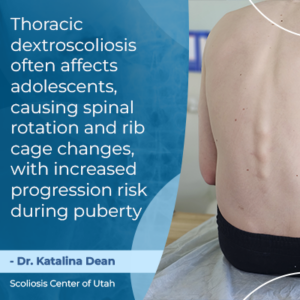 Thoracic dextroscoliosis curves largely affect adolescents affect adolescents in the middle/upper back and body, can cause more rotation, affect the rib cage, and are usually recommended for proactive curve management due to an increasd risk of rapid progression caused by peak growth spurts of puberty.
Early detection and intervention gives clinicians the chance to impact a child’s curve during growth, instead of attempting to reverse the effects of growth-related progression after it’s occurred.
Lumbar Dextroscoliosis
The lumbar spine refers to the lower back and because of its load-bearing nature, the lumbar spine is vulnerable to injury, strain, and back pain.
While adolescent curves are more common in the thoracic spine, the lumbar spine can also develop dextroscoliosis, but right curves in the lower back are more common in older adults with degenerative scoliosis.
Degenerative scoliosis is typically diagnosed in adults over the age of 45 and is usually caused by degenerative instability so most curves are progressive and involve lower back pain.
When parts of the spine are degenerating, the spine’s ability to maintain its healthy curves and alignment may be lost, and when it comes to older adults, there may be a lot of factors driving degenerative curve onset and/or progression including spinal disc and/or facet joint degeneration causing instability, muscle loss causing a lack of spinal support, changing bone health affecting bone density, postural collapse, and/or the cumulative effect of negative lifestyle choices (excess weight, too little exercise, chronic poor posture).
If more than one of these changes are in place, it may have a compounding effect on curve progression and place some patients at risk of injury from a fall.
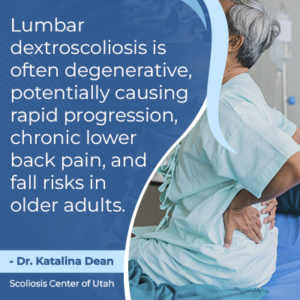 Lumbar dextroscoliosis curves are more often degenerative than idiopathic, can progress quickly, may cause chronic lower back pain, and treatment recommendations may include fall-prevention strategies for older patients.
Thoracolumbar Dextroscoliosis
In cases of thoracolumbar dextroscoliosis, scoliosis develops in the upper lumbar spine and the lower thoracic spine where the middle and lower back meet. The apex of the curve is usually at the bottom of the rib cage and the top of the lumbar spine.
Thoracolumbar dextroscoliosis most often affects adolescents and usually forms a single large C-shaped curve.
Thoracolumbar curves can affect the chest and lower back area for more widespread effects and may pose additional clinical challenges if the curve’s is in the transition zone between the middle and lower back, rather then directly above the lower back, or directly below the middle back.
Conclusion
Here at the Scoliosis Center of Utah, patients who qualify for care are comprehensively assessed so all factors contributing to a patient’s dextroscoliosis and progression risk are considered and addressed with treatment.
Curve direction matters because it indicates the type of curve, whether it’s idiopathic or has an atypical cause, and it also matters because with some severe curves, heart and/or lung function may be affected.
Curve location matters because different spinal sections have different roles to play in how the spine functions, and where scoliosis develops in the spine can also affect curve progression and symptoms.
Dextroscoliosis curves are right-bending and the most common type of scoliosis. It most often develops during early adolescence in the thoracic spine, and lumbar dextroscoliosis most often affects older adults facing degenerative instability.
Additional key factors for treatment planning are patient age and remaining growth potential, curve severity, and curve flexibility.
Treatment recommendations are individualized to support a more aligned and balanced position for the spine, healthy body posture, strong and balanced muscles, and counteract progression.
Dr. Katalina Dean
Dr. Katalina Dean is the founder and clinical director of Scoliosis Center of Utah, in Midvale, UT. Her team specializes in posture correction, spinal rehabilitation, and non-invasive scoliosis care and bracing.
Call Today
Do You Qualify for Care?
Schedule an Appointment Below